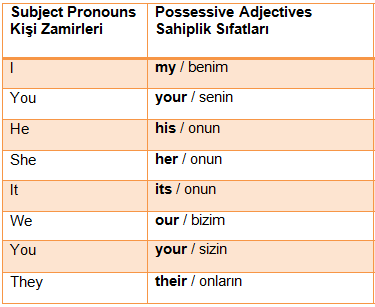
Possessive Case a) ‘Possessive case’ sahiplik durumunun isimlerle birlikte kullanılmasıdır. Bu durumda isimlerin sonuna (‘s) takısı eklenir. The new manager‘s performance is not as satisfactory as we have expected. (Yeni müdürün performansı beklediğimiz kadar tatmin edici değil.) b) İsim çoğulsa, yani sonunda (s) varsa yalnızca (‘) koymak gerekir. The boy‘s mother is in the …
The post Possessive Adjectives appeared first on İngilizceyi Severek Öğren.
]]>
Possessive Case
a) ‘Possessive case’ sahiplik durumunun isimlerle birlikte kullanılmasıdır. Bu durumda isimlerin sonuna (‘s) takısı eklenir.
The new manager‘s performance is not as satisfactory as we have expected.
(Yeni müdürün performansı beklediğimiz kadar tatmin edici değil.)
b) İsim çoğulsa, yani sonunda (s) varsa yalnızca (‘) koymak gerekir.
The boy‘s mother is in the living-room talking to her friend over their exam results.
(Erkek çocuğun annesi, oturma odasında arkadaşıyla onların sınav sonuçları üzerinde konuşuyorlardı.)
c) İsim çoğul, ancak düzensiz ise (‘s) konulur.
The children‘s parents started to be worried since they hadn’t been in sight for a long time.
(Çocukların aileleri, çocuklar uzun zamandır görünürde olmadıkları için endişelenmeye başladılar.)
d) Bazı özel isimlerin sonunda (s) bulunabilir. Bu durumda, özel isimlere mahsus olmak üzere, iyelik özelliği ismin sonuna hem (‘s) konularak, hem de yalnızca (‘) eklenerek ifade edilebilir.
Melis‘s (Melis’) ideas have attracted no attention in the department meeting.
(Melis’in fikirleri bölüm toplantısında ilgi çekmedi.)
e) İyelik özelliği cansız varlıklarda genellikle ‘of’ ile verilir. Ancak, organizasyon isimleriyle (company, firm …) veya Britain, Asia, town, world, city gibi kelimelerle ‘s de kullanılır.
The pages of the book have been torn as it has been used for a long time as a reference book.
(Kitabın sayfaları, uzun zamandır referans kitabı olarak kullanıldığı için yırtık.)
You need to change the colour of the room and choose a lighter one.
(Senin odanın rengini değiştirmene ve daha açık bir renk seçmene ihtiyacın var.)
the city’s landscape – the landscape of the city
the firm’s administrative staff – the administrative staff of the firm
f) ‘s zaman sözcüklerinin yanı sıra süreç bildiren sözcük ve kalıplarla da kullanılır.
I saw the ad in yesterday’s newspaper.
(Dünün gazetesinde reklamı gördüm.)
ÖRNEK
Urbanization and globalization will be discussed in tomorrow’s session.
Never expect to be successful after just one hour’s study!
I felt myself completely numb and lazy after twelve hours’ sleep.

- Have you taken your new torch with you?
(Sen yanına yeni meşaleni aldın mı?)
- It is John‘s book. = It is his book. (O, onun-John’un- kitabı.)
- They are my friends’ bikes. = They are their bikes.
(Onlar, onların-benim arkadaşlarımın- bisikletleri.)
- A stone hit me on the head while I was passing by children’s playground.
(Çocukların oyun bahçesinden geçiyorken başıma taş çarptı.)
- One of my friends had a terrible pain in the stomach yesterday.
(Arkadaşlarımın birisinin dün karnında berbat-kötü bir ağrı vardı.)
- One has an obligation to one’s friends. (Birinin arkadaşlarına zorunluluğu var.)
- Whose book is this? (Bu kimin kitabı?)
- I have lost my pen. (NOT …the my pen) (Ben kalemimi kaybettim.)
- James has decorated his new house in such a way that its style charms everyone.
(James yeni evini, tarzını herkesi büyüleyecek şekilde dekore etti.)
- Peter and Sarah have decided to get married in the summer and they think that their wedding will be an unforgettable one.
(Peter ve Sarah, yazın evlenmeye karar verdiler ve onlar düğünlerinin unutulmaz bir düğün olacağını düşünüyorlar.)
- My friends and I are working for a charity and we donate some of our pocket money there.
(Benim arkadaşlarım ve ben bir hayırsever kurumu için çalışıyoruz ve bizim poşet paralarımızın bazılarını bağışlıyoruz.)
- I don’t need your trekking equipment; I’ve brought my own rope and helmet.
(Senin yürüyüş ekipmanına ihtiyacım yok; ben kendi ipimi ve miğferimi aldım.)
- You can’t find the chart in this computer as Mike wrote it on his own laptop.
(Mike onu kendi bilgisayarında yazdığı için sen bu bilgisayarda çizelgeyi bulamazsın.)
- Dora has always longed for a house of her own/ her own house.
(Dora genellikle kendi evini özledi.)
- I can’t understand why she likes having a holiday on her own. (alone – by herself)
(Ben onun tek başına tatile gitmeyi neden sevdiğini anlamıyorum.)
- It was a real success for the kids to clean the whole garage on their own. (without help – by themselves)
(Bütün garajı yardım almadan temizlemek çocuklar için gerçek başarıydı.)
The post Possessive Adjectives appeared first on İngilizceyi Severek Öğren.
]]>PRONOUNS İsimlerin yerine kullanılan sözcüklere zamir ( pronoun )denir. Cümle içerisinde özne ya da nesne yerine geçebilir, aitlik anlamı verebilir ya da öznenin kendi yaptığı işten etkilendiğini ifade edebilirler. Zamirler; subject pronouns, object pronouns, possessive pronouns, possessive adjectives ve reflexive pronouns olarak beşe ayrılır. SUBJECT PRONOUNS I ( ben ) YOU ( sen ) HE …
The post SUBJECT PRONOUNS appeared first on İngilizceyi Severek Öğren.
]]>PRONOUNS
İsimlerin yerine kullanılan sözcüklere zamir ( pronoun )denir. Cümle içerisinde özne ya da nesne yerine geçebilir, aitlik anlamı verebilir ya da öznenin kendi yaptığı işten etkilendiğini ifade edebilirler. Zamirler; subject pronouns, object pronouns, possessive pronouns, possessive adjectives ve reflexive pronouns olarak beşe ayrılır.
SUBJECT PRONOUNS
I ( ben )
YOU ( sen )
HE ( erkekler için ‘o’ )
SHE ( kızlar için ‘o’ )
IT ( cansız varlıklar için ‘o’ )
WE ( biz )
THEY ( onlar )
Cümlede özne yerine kullanılırlar. Ayrıca, daha önceden bahsedilen ve bu nedenle bilinen öznelerden bahsederken kullanılırlar.
- I know him. ( Ben onu tanıyorum.)
- Mike is sick. He will be away for a few days.( Mike hasta. O birkaç gün uzak olacak.)
- She lives in İstanbul. (O İstanbul’da yaşar.)
Özneler,bağlaçlarla birleştikleri zaman da öznedirlerdir. Cümle içerisinde ‘and’ , ‘or’ , ‘but’ ile birlikte birden fazla sözcüğün özneyi oluşturabileceği unutulmamalıdır. Dolayısıyla bu sözcüklerden bazılarının zamir olması bir şey değiştirmeyecektir.
- My friend John and … decided to stay at home instead of going out last night. (Arkadaşım John ve ben dün gece dışarı çıkmak yerine evde kalmaya karar verdik).
- a) I ( doğru)
- b) me ( yanlış)
‘One’ , ‘You’ , ‘They’ şahıs zamirleri insanlardan genel anlamda bahsetmek istendiğinde kullanılabilir.
- One/You cannot learn a foreign language in three months. (Birisi/ Sen üç ayda yabancı bir dil öğrenemez/ öğrenemezsin.)
- They say one apple a day prevents cancer. (Onlar günde bir elmanın kanseri engellediğini söylüyorlar.)
- One shouldn’t believe everything that one watches on TV. ( Biri televizyonda izlediği her şeye inanmamalıdır.)
‘ One’ özne veya nesne olabilir. “ One’s” şeklinde sahiplik eki alabilir. Reflexive pronoun( dönüşlülük zamiri) hali “oneself” şeklindedir.
- She talks to one like a professor. (O profesör gibi biriyle konuşur.)
- One’s family must always come first. ( Birinin ailesi hep öncelikli olmalıdır.)
- One should always give oneself some time to make important decisions. (Biri her zaman önemli kararlar almak için kendine biraz zaman vermelidir.)
Bazı nesneler ve soyut kavramlar “she” zamiriyle ifade edilebilir. Örneğin bir ülke, gemi ya da aşk sözcüğü gibi soyut bir kavram “she” zamiri alabilir. Ancak modern İngilizce’de “it” zamiri daha yaygındır.
- One of the things that made the Titanic so fascinating was that she represented the best of technology when she set sail on her ill-fated voyage in 1912. (Titanic’i büyüleyici yapan şeylerden biri o 1912’de bahtsız yolcuğuna yelken açtığında en iyi teknolojiyi temsil etmesiydi.)
Özellikle cümle tamamlama sorularında, verilen kısımda geçen bir kurum, kuruluş ya da birden çok kişinin bir araya gelmesiyle oluşturulan takımlara, ekiplere ve gruplara cümlelerin devamının sorulduğu kısımlarda “ they” zamiriyle gönderme yapılabilir.
- Naturally, the police need to know as much as possible… .( Doğal olarak, polisler asıl veya şüpheli suç faaliyetiyle başa çıktıklarında mümkün olduğu kadar çok şey bilmeleri gerekir.)
- a) when they deal with actual or suspected criminal activity ( doğru )
- b) once he takes the case ( yanlış )
“It” ifadesi özne zamiri olarak, sadece belirli şeylerin isimlerine gönderme yapmaz, aynı zamanda “it” özne zamirini biz “nothing, anything,everything” gibi “ indefinite( belirsiz)” zamirler dediğimiz ifadelere gönderme yapmak için de kullanabiliriz.
- Nothing happened,did it ? ( Hiçbir şey olmadı, değil mi ? )
- Everything is OK, isn’t it ? ( Her şey tamam, değil mi ? )
“It” özne zamiri aynı zamanda bütün bir gerçekliğe, olaya veya duruma gönderme yapabilir.
- Our bags were stolen. It totally ruined our vacation. ( Bizim çantalarımız çalındı. O tamamen tatilimizi mahvetti.)
- I did my best to rescue the boy, but it wasn’t enough. (Ben çocuğu kurtarmak için elimden gelenin en iyisini yaptım, ama o yeterli değildi.)
- It’s so bad; everybody is ill, and the central heating is out of order. ( O çok kötü; herkes hasta, merkezi ısıtma bozuk.)
Zamana, havaya, sıcaklığa ve mesafelere gönderme yapan ifadelerle birlikte belirli herhangi bir ismin yerine geçmeyen, sadece yapısal olarak kullanılan “empty subject” dediğimiz “it” zamirini kullanırız.
- It’s five o’clock. (Saat 5.)
- It’s been raining all day. ( Bütün gün yağmur yağıyor.)
- It’s five kilometers to the nearest police station. ( En yakın polis karakolu 5 kilometre.)
- It’s Saturday again. ( Yine cumartesi.)
- It’s twenty degrees. (20 derece.)
“We” ve siz anlamına gelen çoğul “You” (diğerlerinin hiçbiri olmaz) isimlerden önce doğrudan getirilebilir.
- We men know things that you women will never understand. (Biz erkekler siz kadınların asla anlayamayacağı şeyleri biliyoruz.)
Geleneksel olarak İngilizce’de bir kişinin cinsiyeti bilinmediğinde veya erkeklere de kadınlara da yorumlanabilecek göndermelerde he kullanılmıştır.
- If a student wants to apply for the scholarship, he must send his CV first. ( Eğer bir öğrenci bursa başvurmak istiyorsa o ilk önce CV’ni göndermelidir.)
The post SUBJECT PRONOUNS appeared first on İngilizceyi Severek Öğren.
]]>