One, ones “Do you need a pen ?” “No, thanks. I already have one.” I prefer light colours to dark ones. The shopkeeper showed me two T-shirts and I bought the one with some flower patterns on. The students in class B have got much better scores than the ones in C. The small buildings …
The post Substitution About Pronouns appeared first on Learn English Fondly.
]]>One, ones

- “Do you need a pen ?” “No, thanks. I already have one.”
- I prefer light colours to dark ones.
- The shopkeeper showed me two T-shirts and I bought the one with some flower patterns on.
- The students in class B have got much better scores than the ones in C.
- The small buildings over there belong to the staff but those large ones are where the administrators stay.
- “I would like to try that shirt on.” “Which one?” “The blue one.”
- “Those students in the back row are from the States, but the ones in the front line are from Canada.”
- Don’t make a sudden decision to work in that company; you deserve a better one with your qualifications.
- The bowl was so small for the salad she made that she had to use two large ones to serve it.
- Don’t insist on answering all the questions in this book; those ones in the worksheet will be enough for revision.
- The band that performed the last in the contest was also the best (one).
- Which (one) would you like to buy out of these two dresses? I will buy the black one if you buy the other (one).
- Please, don’t wear this pink tie; get another (one).
- The one who is standing over there is our landlady.
- Dolores has filed the ones which belong to past year’s clients.
That of / Those of
- I can’t imagine a greater life than that of a teacher. (… than the life of a teacher)
- We should admit that the responsibilities of mothers are far more serious than those of fathers. (the responsibilities of fathers)
One of
- one of his books
- one of the/my/those birds (NOT one of birds)
- One of the cars in the parking lot has been sold.
- One of my classmates was awarded a scholarship in Canada.
- İstanbul is known as one of the most beautiful places not only in Europe but also in the whole world.

- Why don’t you ask one of the crew?
One or it
- I have to get a ticket to travel on public buses but I don’t know where I can get one. .)
- Take this card and don’t lose it; or else, you won’t be allowed to enter there.
- I haven’t got a calculator and I need one for the calculus class.
BUT
- “Have you seen my calculator around here?” “Yes, I’ve just seen it on your desk.”
The post Substitution About Pronouns appeared first on Learn English Fondly.
]]>It is used in the cases which people are affected by their work themselves, in other words, in the cases which subject and object are the same person. Look at your arm. You have painted yourself. I cut myself while I was peeling potatoes for dinner. Talking to oneself is the first sign of madness. …
The post Reflexive Pronouns appeared first on Learn English Fondly.
]]>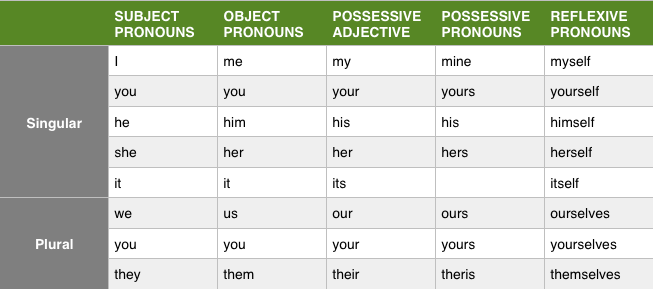
FOR EXAMPLEIt is used in the cases which people are affected by their work themselves, in other words, in the cases which subject and object are the same person.
- Look at your arm. You have painted yourself.
- I cut myself while I was peeling potatoes for dinner.
- Talking to oneself is the first sign of madness.
FOR EXAMPLEReflexive pronouns can apostrophize to possessive statements and objects as well.
- Her stories are all about herself.
FOR EXAMPLE‘Object pronoun’ is used after a preposition reporting place, not ‘reflexive pronoun’.
- I didn’t have any money with … .
a) her (true) b) myself (false)
- She didn’t see the car behind … while she was parking.
a) her (true) b) herself (false)
- He is very angry with himself.
(It should be noted that the act of anger returns to the subject by using reflexive pronouns because there is a possibility of being angry with someone else in this sentence.)
FOR EXAMPLEReflexive pronoun structures can be used in sentence at different places to emphasize at meaning “my own self, me myself and I / in the flesh, in person”.
- I myself want to see the manager.
- They talked to the doctor himself.
FOR EXAMPLEReflexive pronoun structures can be used at meaning “alone” or “without help from anyone else” in form of”by+reflexive pronoun”. This meaning can be given with the usage of ‘on my/his/their own’.
- The old woman lives by herself in an enormous house.
- Hillary was only four but she wrote her name all by herself.
- It’s a big garden, but we do all the gardening (by) ourselves.
- Little Tom made that cake all by himself.
FOR EXAMPLEThere are some idioms used with ‘reflexive pronouns’. Please, examine the examples below.
- I hope the fanatic supporters behave themselves this time. (stand smarter)
- Please help yourself to the food, won’t you? (When someone is asked to buy from foods and drinks, it is used at meaning “go ahead”.)
- Please make yourself at home. (It is used when someone is invited and told to comfort oneself as if one self home.)
FOR EXAMPLEReflexive pronouns can be used in order to emphasize.
- Do it yourself.
- The house itself is nice, but the garden is very small.
FOR EXAMPLEThere is not reflexive structure describing possessive. Instead, “my own, your own, his own etc.” usages are used.
- I only wash my own clothes. (NOT …myself’s clothes)
FOR EXAMPLE:-DThe verbs as “wash, dress, shave” are not used with reflexive pronouns in English.
- I shave on Mondays. (NOT …shave myself)
FOR EXAMPLEHowever, reflexive pronouns can be used when it need to clear who the action is made by.
- My son is old enough to dress himself.
FOR EXAMPLEThose are other some verbs which are not used with reflexive pronouns:
- All of a sudden, one of the windows opened.
- Her latest book is selling well.
- You should try to concentrate.
- I feel funny. (NOT I feel myself funny.)
FOR EXAMPLE“Reflexive pronouns” are used in the sentences that its subject and its object are same. It indicates that the subject is influenced by his/her work.
- After years of experience, I have taught myself to tolerate people.
- As we were waiting for the results, we all prepared ourselves for the worst.
- I feel nervous.
- Hande couldn’t concentrate on the film due to the noise.
- We were filled with joy when we saw our two-year old son dressed himself.
FOR EXAMPLEWhen it is used with ‘by’ preposition, it is emphasized that the action was made only by that person without help.
- You should learn to get over troubles by yourself.
- It is not advisable to let little children play near the swimming pool by themselves.
FOR EXAMPLEThese pronouns can characterise both subject and object.
- Grandad saw Atatürk himself in 1930.
- I talked to the children themselves; I didn’t complain to their parents.
FOR EXAMPLE“Reflexive pronouns” can be used after a preposition.
- She only thinks of herself.
- When her mind is too busy with something, Laura talks to herself.
FOR EXAMPLEHowever, “reflexive pronouns” cannot be used, and “object pronouns” is used if the preposition in the sentence is used for locating.
- Martha placed her handbag in front of her.
- Please, don’t bring your cousin with you because she is too naughty.
enjoy oneself / help oneself / be proud of oneself / take care of oneself / make oneself at home / behave oneself
- I hope you will like the film. Enjoy yourself!
- Come on kids! Help yourselves to these delicious chocolate cookies!
The post Reflexive Pronouns appeared first on Learn English Fondly.
]]>The car in the front is mine. There are many keys here. Which of these are yours? a former colleague of mine an old friend of hers ➡ I met another colleague of … yesterday …
The post Possessive Pronouns appeared first on Learn English Fondly.
]]>
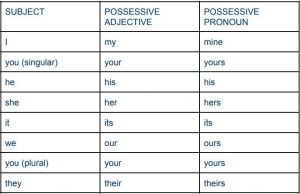

- The car in the front is mine.
- There are many keys here. Which of these are yours?
- a former colleague of mine
- an old friend of hers
 I met another colleague of … yesterday
a) hers (true) b) her (false)
- Whose book is this?
- Whose is this book?
- It’s important to have a belief of one’s own. (NOT ……of one’s)
- I’ve eaten my fish and the cat has eaten its fish too. (NOT ……and the cat has eaten its.)
- A: My bike is broken. Can I borrow yours?
B: Why don’t you ask Dan?
A: I can’t use his as it is too big.
B: Ok. I can give you mine as long as you bring it back before dinner.
- Casie is a neighbour of James’./She is a neighbour of his.
- Bob and Patrick called a friend of theirs to ask for money.
- At the end of the term we went on a picnic with a teacher of ours and had quite a nice time together.
- What do you think of this new haircut of mine?
- My aunt showed me a few photographs of me, which she took in her own house.
- I showed my aunt some of the photographs of mine when I went to Long Lead.
- The soldier was wounded on the head.
- I suddenly turned back when someone tapped me on the shoulder.
The post Possessive Pronouns appeared first on Learn English Fondly.
]]>Possessive Case a) ‘Possessive case’ is that possessive situation is used with nouns. In this case, it is added (‘s) suffix to the end of the nouns. The new manager‘s performance is not as satisfactory as we have expected. b) If a noun is plural; that is there is (s) suffix at the end of the …
The post Possessive Adjectives appeared first on Learn English Fondly.
]]>
Possessive Case
a) ‘Possessive case’ is that possessive situation is used with nouns. In this case, it is added (‘s) suffix to the end of the nouns.
The new manager‘s performance is not as satisfactory as we have expected.
b) If a noun is plural; that is there is (s) suffix at the end of the noun, it is only put (‘) .
The boy‘s mother is in the living-room talking to her friend over their exam results.
c) If the noun is plural but irregular, it is put (‘s) suffix.
The children‘s parents started to be worried since they hadn’t been in sight for a long time.
d) (s) suffix may be found at the end of some proper nouns. In this case, possessive feature can be expresses both by being put (‘s) suffix to the end of the noun and by only being added (‘) suffix on condition that proper nouns pertain to.
Melis‘s (Melis’) ideas have attracted no attention in the department meeting.
e) Possessive feature always is given with ‘of’ at inanimate entities. However, ‘s is also used with organization names (company,firm …) or words such as Britain, Asia, town, world, city.
The pages of the book have been torn as it has been used for a long time as a reference book.
You need to change the colour of the room and choose a lighter one.
the city’s landscape – the landscape of the city
the firm’s administrative staff – the administrative staff of the firm
f) ‘s is also used with words and patterns besides time words.
I saw the ad in yesterday’s newspaper.
FOR EXAMPLE
Urbanization and globalization will be discussed in tomorrow’s session.
Never expect to be successful after just one hour’s study!
I felt myself completely numb and lazy after twelve hours’ sleep.
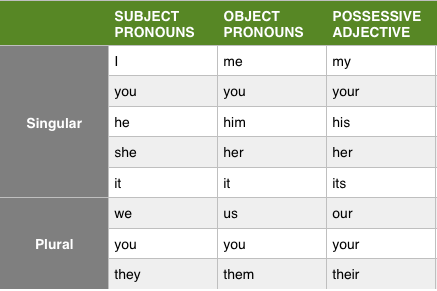
- Have you taken your new torch with you?
- It is John‘s book. = It is his book.
- They are my friends’ bikes. = They are their bikes.
- A stone hit me on the head while I was passing by children’s playground.
- One of my friends had a terrible pain in the stomach yesterday.
- One has an obligation to one’s friends.
- Whose book is this?
- I have lost my pen. (NOT …the my pen)
- James has decorated his new house in such a way that its style charms everyone.
- Peter and Sarah have decided to get married in the summer and they think that their wedding will be an unforgettable one.
- My friends and I are working for a charity and we donate some of our pocket money there.
- I don’t need your trekking equipment; I’ve brought my own rope and helmet.
- You can’t find the chart in this computer as Mike wrote it on his own laptop.
- Dora has always longed for a house of her own/ her own house.
- I can’t understand why she likes having a holiday on her own. (alone – by herself)
- It was a real success for the kids to clean the whole garage on their own. (without help – by themselves)
The post Possessive Adjectives appeared first on Learn English Fondly.
]]>Object Pronouns mean article of pronouns. Object pronouns replace the noun which is in case of object in the sentence. I bought her a birthday present. I bought a birthday present for her. You can take your jacket off if you like. You can take off your jacket if you …
The post OBJECT PRONOUNS appeared first on Learn English Fondly.
]]>Object Pronouns mean article of pronouns. Object pronouns replace the noun which is in case of object in the sentence.
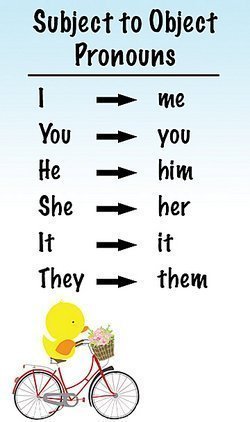
- I bought her a birthday present.
- I bought a birthday present for her.
- You can take your jacket off if you like.
- You can take off your jacket if you like.
- My sister is nearly as tall as me.
- I can run faster than him.
- My brother is as handsome as I am.
- Nobody but her would do such a crazy thing. (More formal: Nobody but she …)
- Everybody agreed except (for) me. (NOT … except I)
a) object pronoun + that (informal)
FOR EXAMPLE
- It was him that rescued the kids.
b) subject pronoun + who (formal)
FOR EXAMPLE
- It is I who need your advice.
- It was he who rescued the kids.
- He was the person/ the one who rescued the kids.
- It is for her to decide (NOT It is for she to decide).
- She was carrying a bag with thousands of dollars in (it).
- The cake was too beautiful to eat. (NOT …too beautiful to eat it)
Instead of nouns or noun groups which are in case of object in the sentence:
FOR EXAMPLE
- I saw Felicia crying yesterday but I didn’t ask her the reason.
- The girls in the school basketball team played very well and the coach thanked them for their great effort.
- Everything was arranged for the summit but the chairman postponed it to the following week.
When you want to use pronoun after prepositions:
FOR EXAMPLE
- Caroline is my best friend so please don’t talk behind her, at least when you are with me.
At structures of comparative that adjectives and adverbs are used:
FOR EXAMPLE
- I don’t speak English as fluently as him because he has been to Britain several times.
- The neighbours next door are a lot noisier than us as they have got three little children.
- My brother is more stubborn than I am.
- The Jenkins bought a bigger house than we did.
When it is used independently, not be in a sentence:
FOR EXAMPLE
- Alp: I didn’t like the film much.
Beril: Me, neither.
- Nilly: Who was shouting in the room yesterday?
Bruce: Him, not us.
- Who has left the room in such a mess?
I haven’t. She has.
When ‘it’ pronoun is used as ‘object pronoun’, it may be used in pursuit of verbs such as ‘love’, ‘hate’ that express emotion:
FOR EXAMPLE
- My father likes it that our family comes together on special occasions.
- Ahmet hates it when somebody criticizes his ambition in business.
In the usage “find / make / think… + it + adjective”:
FOR EXAMPLE
- When Evelyn went to Toronto for the first time, she found it hard to adapt to the city life.
- Only two of us left the hall earlier because the concert was quite boring.
- Sam sent her CV to several companies but only one of them called her for an interview.
The post OBJECT PRONOUNS appeared first on Learn English Fondly.
]]>The Simple Past Tense, sometimes called the "Preterite", is used to talk about a completed action in a time before now. The Simple Past Tense is the basic form of past tense in English. The time of action can be in the recent past or the distant past and action duration is not important.
The post SIMPLE PAST TENSE appeared first on Learn English Fondly.
]]>The Simple Past Tense, sometimes called the “Preterite”, is used to talk about a completed action in a time before now. The Simple Past Tense is the basic form of past tense in English. The time of action can be in the recent past or the distant past and action duration is not important.
 SIMPLE PAST FORM
S(Subject) + V2 (The second state of the verb) + O(Object)
For Positive Sentences;
S(Subject) + V2(The second state of the verb) + O(Object)
FOR EXAMPLE
- I came to the home immediately.
- Jane Austen began to write the novel in her teenage years.
For Negative Sentences;
S(Subject) + did not (didn’t) + V1(The bare infinitive)
FOR EXAMPLE
- She went shopping yesterday, but she didn’t buy anything.
- I didn’t get up very early yesterday.
For Question Sentences;
DID + S(Subject) + V1(The bare infinitive)
FOR EXAMPLE
- Did the manager call me yesterday ?
- Did you go to the school two weeks ago ?
TIME EXPRESSIONS FREQUENTLY USED IN SIMPLE PAST TENSE
yesterday
ago
last week / year / month …
then
in 1998 / in the 14th century …
at the time
at that time
previously
in ancient times
in antiquity
when
whenever
while
after
before
until
as soon as
the moment
immediately after
soon after
frequency adverbs ( always / never / sometimes … )
the other day
that day

THE VERBS
TO BE , TO HAVE, TO DO
| SUBJECT | VERB | VERB | VERB |
| TO BE
(am,is,are) |
TO HAVE
(have has) |
TO DO | |
| I | WAS | HAD | DID |
| YOU | WERE | HAD | DID |
| HE,SHE,IT | WAS | HAD | DID |
| WE,YOU,THEY | WERE | HAD | DID |
THE REGULAR VERBS
- Last Monday, all the staff started a new training programme.
- He smoked two packets of cigarattes a day when he was young.
- They studied hard for the exam together.
 THE IRREGULAR VERBS
| SIMPLE PRESENT | SIMPLE PAST | PAST PARTICIPLE |
| be | was, were | been |
| become | became | become |
| begin | began | begun |
| bend | bent | bent |
| bet | bet | bet |
| bite | bit | bitten |
| blow | blew | blown |
| break | broke | broken |
| bring | brought | brought |
| build | built | built |
| burn | burned/burnt | burned/burnt |
| burst | burst | burst |
| buy | bought | bought |
| catch | caught | caught |
| choose | chose | chosen |
| come | came | come |
| cost | cost | cost |
| cut | cut | cut |
| deal | dealt | dealt |
| dig | dug | dug |
| dive | dived/dove | dived |
| do | did | done |
| draw | drew | drawn |
| dream | dreamed/dreamt | dreamed/dreamt |
| drink | drank | drunk |
| drive | drove | driven |
| eat | ate | eaten |
| fall | fell | fallen |
| feed | fed | fed |
| feel | felt | felt |
| fight | fought | fought |
| find | found | found |
| fit | fit/fitted | fit/fitted |
| fly | flew | flown |
| forbid | forbade | forbidden |
| forget | forgot | forgotten |
| forgive | forgave | forgiven |
| freeze | froze | frozen |
| get | got | got/gotten |
| give | gave | given |
| go | went | gone |
| grow | grew | grown |
| hang | hung/hanged | hung/hanged |
| have | had | had |
| hear | heard | heard |
| hide | hid | hidden |
| hit | hit | hit |
| hold | held | held |
| hurt | hurt | hurt |
| keep | kept | kept |
| know | knew | known |
| lay | laid | laid |
| lead | led | led |
| leave | left | left |
| lend | lent | lent |
| let | let | let |
| lie (down) | lay | lain |
| light | lit/lighted | lit/lighted |
| lose | lost | lost |
| make | made | made |
| mean | meant | meant |
| meet | met | met |
| pay | paid | paid |
| put | put | put |
| quit | quit | quit |
| read | read | read |
| ride | rode | ridden |
| ring | rang | rung |
| rise | rose | risen |
| run | ran | run |
| saw | sawed | sawed/sawn |
| say | said | said |
| see | saw | seen |
| seek | sought | sought |
| sell | sold | sold |
| send | sent | sent |
| set | set | set |
| sew | sewed | sewn/sewed |
| shake | shook | shaken |
| shave | shaved | shaved/shaven |
| shine | shone/shined | shone/shined |
| shoot | shot | shot |
| show | showed | shown/showed |
| shut | shut | shut |
| sing | sang | sung |
| sink | sank | sunk |
| sit | sat | sat |
| sleep | slept | slept |
| slide | slid | slid |
| speak | spoke | spoken |
| speed | sped | sped |
| spend | spent | spent |
| spread | spread | spread |
| stand | stood | stood |
| steal | stole | stolen |
| stick | stuck | stuck |
| sting | stung | stung |
| strike | struck | struck/stricken |
| swear | swore | sworn |
| sweep | swept | swept |
| swim | swam | swum |
| take | took | taken |
| teach | taught | taught |
| tear | tore | torn |
| tell | told | told |
| think | thought | thought |
| throw | threw | thrown |
| understand | understood | understood |
| wake | woke/waked | woken/waked |
| wear | wore | worn |
| win | won | won |
| wind | wound | wound |
| withdraw | withdrew | withdrawn |
| write | wrote | written |
- It’s (high) time / It’s about time you studied for your exam.
The post SIMPLE PAST TENSE appeared first on Learn English Fondly.
]]>The post Level Test appeared first on Learn English Fondly.
]]>The post Level Test appeared first on Learn English Fondly.
]]>SIMPLE PRESENT TENSE Simple Present Tense mentions verbs that we always do and general truth. AFFIRMATIVE I save money. YOU save money. WE save money. THEY save money. NOTE: Infinitive form of the verb –that’s bore infinitive are used with subjects “I,YOU,WE and THEY” at Simple Present Tense. *** HE saves money. SHE saves …
The post SIMPLE PRESENT TENSE appeared first on Learn English Fondly.
]]>SIMPLE PRESENT TENSE
Simple Present Tense mentions verbs that we always do and general truth.
AFFIRMATIVE
I save money.
YOU save money.
WE save money.
THEY save money.
NOTE: Infinitive form of the verb –that’s bore infinitive are used with subjects “I,YOU,WE and THEY” at Simple Present Tense.
*** HE saves money.
SHE saves money.
IT saves money.
NOTE: “HE,SHE and IT” subjects’ verbs take “-s, -es, -ies” suffixes.
NEGATIVE
I don’t save money.
YOU don’t save money.
HE doesn’t save money.
SHE doesn’t save money.
IT doesn’t save money.
WE don’t save money.
YOU don’t save money.
THEY don’t save money.
NOTE: Negation Particle “NOT” is used at the negative sentences. “NOT” means no.It is used with “DO NOT(DON’T)” auxiliary verb and the infinitive form of the verb after the subjects “I, YOU, WE and THEY”. It is used with “DOES NOT(DOESN’T)” auxiliary verb and the infinitive form of the verb after the subject “HE, SHE and IT”.
QUESTION
DO I save money ?
DO you save money ?
DO we save money ?
DO they save money ?
DOES he save money ?
DOES she save money ?
DOES it save money ?
NOTE: DO and DOES come to the fore, then the subject and the infinitive form of the verb are used at the question sentences.
TIME EXPRESSIONS FREQUENTLY USED IN SIMPLE PRESENT TENSE
always
almost always/nearly always
usually
generally
often
frequently
sometimes
occasionally
seldom
rarely
scarcely
scarcely ever
barely
ever
not ever
never
almost never
at times
once in a while
from time to time
now and then
every day/week/month/summer …
once/twice … a month/ a year …
at the weekends/on weekends
on Mondays/Sundays …
on weekdays
in the mornings/at nights …
every two days/every three weeks …
- Habits, repeated actions:
*During weekdays, I try to get an eight-hour sleep so that I can feel energetic at work.
*As a teacher, Semra always has extra work to do at home because she prepares lesson plans for the next day.
- Generalisations, natural laws, universal truths:
*Hurricanes occur when the warm air from the surface of the ocean rises and meets the cooler air.
*Trees grow more quickly when they are young.
- Situation or actions that its validity is continuous and permanent:
*Brian lives in a modest house although he earns quite a lot of money.
*Harrods, the famous shopping mall in Britain, sells a large variety of goods.
- Present time expression that is formed without using “-ing” appendix with the verbs that don’t include actions but reporting the situation:
*Serkan doesn’t know how to use the fax machine so he needs your help.
*She wants to ask a question but she doesn’t want to interrupt him now.
- Headlines:
*Germany beats Argentina in the semi finals of the 2010 World Cup.
*Prime Minister attends a special ceremony and makes a speech there.
- Book, movie summaries; story, short feature telling and sport reviews:
*One day, the princess comes to the palace and comes together to her father.
*Messi kicks the ball and scores the goal of his team.
- Performative verbs ( accept, acknowledge, assume, believe, deny, hope,
inform, promise, think…) :
*I believe in faeries.
*I hope you won’t expect results immediately.
USE OF FREQUENCY ADVERBS IN SIMPLE PRESENT TENSE
- If we want to know how often an act is done, we need to ask “How often” question to the verb.
*Mary is always in charge.
*I never promise anybody anything.
- Frequency adverbs are always used between the subject and the verb before the actual verb. But this adverbs are used after the verb “be(am, is, are)”.
*Our teacher usually lets us free.
*Elena is sometimes pessimistic about the future of the company due to the economic crisis.
- But if “be” verb is in negative construction, the usage may change.
*My sister sometimes isn’t pleased with surprises.
VERY IMPORTANT
“Always” must indicate after the appendix that specifies negative.
*First impressions aren’t always correct.
- “Usually, normally, often, frequently, sometimes ve occasionally” may locate at the beginning or end of the sentences. But, “always, never, rarely ve seldom” don’t always locate at the beginning or end of the sentence.
*Sometimes I enjoy playing computer games especially after a hard day.
- “Frequently, sometimes, occasionally” must come before the negative auxiliary verb.
*He sometimes doesn’t feel like going to work. ( feel like= wish, want )
- “Usually, generally, often” may come after the negative auxiliary verb or before the negative auxiliary verb.
*My mother doesn’t often go shopping herself; instead, she prefers shopping online.
- “Never, seldom, rarely, hardly ever” carry negative meaning. This adverbs are used with the positive verb structure but they make negative the meaning of the sentence.
*My son never makes his bed, which always drives me crazy.
VERY IMPORTANT
If the adverbs that carry negative meaning locate at the beginning of the sentence, it is compulsory that the sentence is made inverted.
** Rarely do I watch football matches.
**Never does Smith show tolerance to his employees if anything goes wrong.
The post SIMPLE PRESENT TENSE appeared first on Learn English Fondly.
]]>PRONOUNS Words used in place of names are called pronouns. They can replace the subject or the object in the sentence, can give meaning to belonging or can express that the subject was influenced by its own work. Pronouns are divided into five as Subject Pronouns, Object Pronouns, Possessive Pronouns, Possessive Adjectives and Reflexive …
The post SUBJECT PRONOUNS appeared first on Learn English Fondly.
]]>PRONOUNS
Words used in place of names are called pronouns. They can replace the subject or the object in the sentence, can give meaning to belonging or can express that the subject was influenced by its own work. Pronouns are divided into five as Subject Pronouns, Object Pronouns, Possessive Pronouns, Possessive Adjectives and Reflexive Pronouns.
SUBJECT PRONOUNS
I
YOU
HE
SHE
IT
WE
THEY
- They are used in place of the subject in the sentence. In addition, it is used previously mentioned subjects and therefore, when mentioning the known subjects.
- I know him.
- Mike is sick. He will be away fo a few days.
- She lives in İstanbul.
- Subjects are also subject when they combine with the It shouldn’t be forgotten that with “and” , “or” , “but” in the sentence, multiple words can create the subject. Therefore, some of these words will not change anything to be pronoun.
- My friend John and … decided to stay at home instead of going out last night.
- I ( true )
- me ( false )
- “One” , “You” , “They” the subject pronouns can be used when it is asked to mention about people in general.
- One/You cannot learn a foreign language in three months.
- They say one apple a day prevents cancer.
- One shouldn’t believe everything that one watches on TV.
- “One” can be the subject or the object. It can take possessive appendix in the form of “One’s”. The aspect of Reflexive Pronoun is in the form of “oneself”.
- She talks to one like a professor.
- One’s family must always come first.
- One should always give oneself some time to make important decisions.
- Some objects and abstract concepts can be expressed with “she” pronoun. For example, a abstract concept as a country, ship or love word can take “she” pronoun. But “it” is more common in Modern English.
- One of the things that made the Titanic so fascinating was that she represented the best of technology when she set sail on her ill-fated voyage in 1912.
- Especially in sentence completion questions, it is brought “they” pronoun to the given part if the institution,foundation, team or group that is mentioned in the previous sentence is.
- Naturally, the police need to know as much as possible… .
- when they deal with actual or suspected criminal activity ( true )
- once he takes the case ( false )
- “It” statement doesn’t only refer to the names of certain things as subject pronoun, we may also use “it” subject pronoun to refer to statements that we call “indefinite” pronouns like “ nothing, anything, everything” .
- Nothing happened, did it ?
- Everything is OK, isn’t it ?
- “It” subject pronoun may also refer to an entire reality, event or situation.
- Our bags were stolen. It totally ruined our vacation.
- I did my best to rescue the boy, but it wasn’t enough.
- It’s so bad; everybody is ill, and the central heating is out of order.
- We use “it” pronoun that we call “empty subject”; which is only used as structural, doesn’t replace any specific name with statements that refer to time, air, temperature and distances.
- It’s five o’clock.
- It’s been raining all day.
- It’s five kilometers to the nearest police station.
- It’s Saturday again.
- It’s twenty degrees.
- “We” and “You” plural that mean you ( None of the others do ) could be brought directly before nouns.
- We men know things that you women will never understand.
- Traditionally, in English when a person’s gender isn’t known or in the submissions that can be interpreted to men and women he is used.
- If a student wants to apply for the scholarship, he must send his CV first.
The post SUBJECT PRONOUNS appeared first on Learn English Fondly.
]]>TO BE ‘TO BE’ is basic verb that we use when we want to qualify objects around us and specify their properties, locations. When you set up a sentence in English, a verb is always There is no sentence in which there is no verb. A verb cannot be seen at first glance like …
The post TO BE appeared first on Learn English Fondly.
]]>TO BE
- ‘TO BE’ is basic verb that we use when we want to qualify objects around us and specify their properties, locations. When you set up a sentence in English, a verb is always There is no sentence in which there is no verb.
- A verb cannot be seen at first glance like sentences ‘Mary is fat’ or ‘Jane is beautiful’ . These are noun and adjective verbs in Turkish grammar. However, there are no constructions such as noun and adjective verbs in English. So when we set up nouns and adjective clauses, we fill this void with verb ‘ to be’ .
- In short, ‘ TO BE’ specifies either the object or the object that characterizes the adjective. TO BE clauses aren’t definitely an action clauses. It cannot describe any structure that contains motion, acceleration.
- To be + adjective
John is handsome.
- To be + noun
Mary is a teacher.
- To be + there is no definitely verb
Now, let’s examine the distribution of TO BE auxiliary verbs according to their pronouns.
| NORMAL SPELLING | ABBREVIATION |
| I am | I’m |
| You are | You’re |
| He is | He’s |
| She is | She’s |
| It is | It’s |
| We are | We’re |
| They are | They’re |
EXAMPLES:
*She is my sister.
*His shoes are dirty.
*Tom is tired.
*Shops are closed.
*Jane is at home.
*I am 21 years old.
*The movie is wonderful.
*Karen’s eyes are green.
*It is Linda’s bag.
*They are in the kitchen.
QUESTIONS and NEGATIVES
When doing negative sentence, it is brought ‘not’ after the auxiliary verb. This pattern is the same all the time in English.
QUESTIONS
am ı…..?
are you…..?
is he…..?
is she…..?
is it…….?
are we…..?
are they……?
EXAMPLES:
*Is she my daughter ?
*Are his shoes dirty ?
*Is Tom tired ?
*Are shops closed ?
*Is Jane at home ?
NEGATIVES
It is used ‘not’ after the auxiliary verb to do negative the sentences made with ‘am-is-are’ auxiliary verbs.
I am not ( no abbreviation )
You are not ( aren’t )
He is not ( isn’t )
She is not ( isn’t )
It is not ( isn’t )
We are not ( aren’t )
They are not ( aren’t )
EXAMPLES:
She isn’t my daughter.
His shoes aren’t dirty.
Tom isn’t tired.
Shops aren’t closed.
Jane isn’t at home.
The post TO BE appeared first on Learn English Fondly.
]]>