Deprecated: Return type of Ai1wm_Recursive_Directory_Iterator::hasChildren($allow_links = true) should either be compatible with RecursiveDirectoryIterator::hasChildren(bool $allowLinks = false): bool, or the #[\ReturnTypeWillChange] attribute should be used to temporarily suppress the notice in /home/ceerenco/learnenglishfondly.com/wp-content/plugins/All-In-One-WP-Migration-With-Import-master/lib/vendor/servmask/iterator/class-ai1wm-recursive-directory-iterator.php on line 57

Deprecated: Return type of Ai1wm_Recursive_Directory_Iterator::rewind() should either be compatible with FilesystemIterator::rewind(): void, or the #[\ReturnTypeWillChange] attribute should be used to temporarily suppress the notice in /home/ceerenco/learnenglishfondly.com/wp-content/plugins/All-In-One-WP-Migration-With-Import-master/lib/vendor/servmask/iterator/class-ai1wm-recursive-directory-iterator.php on line 35

Deprecated: Return type of Ai1wm_Recursive_Directory_Iterator::next() should either be compatible with DirectoryIterator::next(): void, or the #[\ReturnTypeWillChange] attribute should be used to temporarily suppress the notice in /home/ceerenco/learnenglishfondly.com/wp-content/plugins/All-In-One-WP-Migration-With-Import-master/lib/vendor/servmask/iterator/class-ai1wm-recursive-directory-iterator.php on line 42

Deprecated: Return type of Ai1wm_Recursive_Extension_Filter::getChildren() should either be compatible with RecursiveFilterIterator::getChildren(): ?RecursiveFilterIterator, or the #[\ReturnTypeWillChange] attribute should be used to temporarily suppress the notice in /home/ceerenco/learnenglishfondly.com/wp-content/plugins/All-In-One-WP-Migration-With-Import-master/lib/vendor/servmask/filter/class-ai1wm-recursive-extension-filter.php on line 47

Deprecated: Return type of Ai1wm_Recursive_Extension_Filter::accept() should either be compatible with FilterIterator::accept(): bool, or the #[\ReturnTypeWillChange] attribute should be used to temporarily suppress the notice in /home/ceerenco/learnenglishfondly.com/wp-content/plugins/All-In-One-WP-Migration-With-Import-master/lib/vendor/servmask/filter/class-ai1wm-recursive-extension-filter.php on line 37

Deprecated: Return type of Ai1wm_Recursive_Exclude_Filter::getChildren() should either be compatible with RecursiveFilterIterator::getChildren(): ?RecursiveFilterIterator, or the #[\ReturnTypeWillChange] attribute should be used to temporarily suppress the notice in /home/ceerenco/learnenglishfondly.com/wp-content/plugins/All-In-One-WP-Migration-With-Import-master/lib/vendor/servmask/filter/class-ai1wm-recursive-exclude-filter.php on line 41

Deprecated: Return type of Ai1wm_Recursive_Exclude_Filter::accept() should either be compatible with FilterIterator::accept(): bool, or the #[\ReturnTypeWillChange] attribute should be used to temporarily suppress the notice in /home/ceerenco/learnenglishfondly.com/wp-content/plugins/All-In-One-WP-Migration-With-Import-master/lib/vendor/servmask/filter/class-ai1wm-recursive-exclude-filter.php on line 37

Deprecated: Return type of Ai1wm_Recursive_Newline_Filter::accept() should either be compatible with FilterIterator::accept(): bool, or the #[\ReturnTypeWillChange] attribute should be used to temporarily suppress the notice in /home/ceerenco/learnenglishfondly.com/wp-content/plugins/All-In-One-WP-Migration-With-Import-master/lib/vendor/servmask/filter/class-ai1wm-recursive-newline-filter.php on line 28

Deprecated: Return type of WPCF7_FormTag::offsetExists($offset) should either be compatible with ArrayAccess::offsetExists(mixed $offset): bool, or the #[\ReturnTypeWillChange] attribute should be used to temporarily suppress the notice in /home/ceerenco/learnenglishfondly.com/wp-content/plugins/contact-form-7/includes/form-tag.php on line 542

Deprecated: Return type of WPCF7_FormTag::offsetGet($offset) should either be compatible with ArrayAccess::offsetGet(mixed $offset): mixed, or the #[\ReturnTypeWillChange] attribute should be used to temporarily suppress the notice in /home/ceerenco/learnenglishfondly.com/wp-content/plugins/contact-form-7/includes/form-tag.php on line 528

Deprecated: Return type of WPCF7_FormTag::offsetSet($offset, $value) should either be compatible with ArrayAccess::offsetSet(mixed $offset, mixed $value): void, or the #[\ReturnTypeWillChange] attribute should be used to temporarily suppress the notice in /home/ceerenco/learnenglishfondly.com/wp-content/plugins/contact-form-7/includes/form-tag.php on line 516

Deprecated: Return type of WPCF7_FormTag::offsetUnset($offset) should either be compatible with ArrayAccess::offsetUnset(mixed $offset): void, or the #[\ReturnTypeWillChange] attribute should be used to temporarily suppress the notice in /home/ceerenco/learnenglishfondly.com/wp-content/plugins/contact-form-7/includes/form-tag.php on line 552

Deprecated: Return type of WPCF7_Validation::offsetExists($offset) should either be compatible with ArrayAccess::offsetExists(mixed $offset): bool, or the #[\ReturnTypeWillChange] attribute should be used to temporarily suppress the notice in /home/ceerenco/learnenglishfondly.com/wp-content/plugins/contact-form-7/includes/validation.php on line 129

Deprecated: Return type of WPCF7_Validation::offsetGet($offset) should either be compatible with ArrayAccess::offsetGet(mixed $offset): mixed, or the #[\ReturnTypeWillChange] attribute should be used to temporarily suppress the notice in /home/ceerenco/learnenglishfondly.com/wp-content/plugins/contact-form-7/includes/validation.php on line 117

Deprecated: Return type of WPCF7_Validation::offsetSet($offset, $value) should either be compatible with ArrayAccess::offsetSet(mixed $offset, mixed $value): void, or the #[\ReturnTypeWillChange] attribute should be used to temporarily suppress the notice in /home/ceerenco/learnenglishfondly.com/wp-content/plugins/contact-form-7/includes/validation.php on line 98

Deprecated: Return type of WPCF7_Validation::offsetUnset($offset) should either be compatible with ArrayAccess::offsetUnset(mixed $offset): void, or the #[\ReturnTypeWillChange] attribute should be used to temporarily suppress the notice in /home/ceerenco/learnenglishfondly.com/wp-content/plugins/contact-form-7/includes/validation.php on line 139

Deprecated: Constant FILTER_SANITIZE_STRING is deprecated in /home/ceerenco/learnenglishfondly.com/wp-content/plugins/wordpress-seo/src/conditionals/third-party/elementor-edit-conditional.php on line 22

Deprecated: Constant FILTER_SANITIZE_STRING is deprecated in /home/ceerenco/learnenglishfondly.com/wp-content/plugins/wordpress-seo/src/conditionals/third-party/elementor-edit-conditional.php on line 28

Warning: Cannot modify header information - headers already sent by (output started at /home/ceerenco/learnenglishfondly.com/wp-content/plugins/contact-form-7/includes/form-tag.php:8) in /home/ceerenco/learnenglishfondly.com/wp-includes/feed-rss2.php on line 8
possessive arşivleri | İngilizceyi Severek Öğren https://learnenglishfondly.com İngilizceyi Severek,Kolayca,Hızlı Öğren Fri, 09 Aug 2019 15:54:37 +0000 tr hourly 1 https://wordpress.org/?v=6.0.11 Possessive Pronouns Alıştırma https://learnenglishfondly.com/possessive-pronouns-alistirma/ https://learnenglishfondly.com/possessive-pronouns-alistirma/#respond Tue, 06 Aug 2019 14:19:12 +0000 https://learnenglishfondly.com/?p=2174 İngilizceyi Severek Öğren İngilizceyi Severek Öğren - İngilizceyi Severek,Kolayca,Hızlı Öğren

The post Possessive Pronouns Alıştırma appeared first on İngilizceyi Severek Öğren.

]]>
İngilizceyi Severek Öğren İngilizceyi Severek Öğren - İngilizceyi Severek,Kolayca,Hızlı Öğren

The post Possessive Pronouns Alıştırma appeared first on İngilizceyi Severek Öğren.

]]>
https://learnenglishfondly.com/possessive-pronouns-alistirma/feed/ 0
Possessive Pronouns https://learnenglishfondly.com/possessive-pronouns/ https://learnenglishfondly.com/possessive-pronouns/#respond Mon, 05 Aug 2019 10:00:07 +0000 https://learnenglishfondly.com/?p=2125 İngilizceyi Severek Öğren İngilizceyi Severek Öğren - İngilizceyi Severek,Kolayca,Hızlı Öğren

The car in the front is mine. (Öndeki araba benim-benimki.) There are many keys here. Which of these are yours? (Burada bir çok anahtar var. Seninki bunlardan hangisi?) a former colleague of mine (benim eski bir meslektaşım) an old friend of hers (onun eski bir arkadaşı)         ➡ I met another colleague …

The post Possessive Pronouns appeared first on İngilizceyi Severek Öğren.

]]>
İngilizceyi Severek Öğren İngilizceyi Severek Öğren - İngilizceyi Severek,Kolayca,Hızlı Öğren

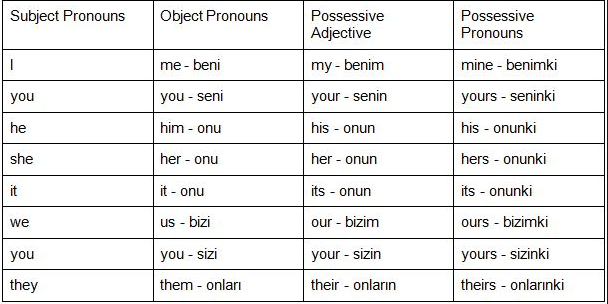
Aitlik zamirleridir ancak aitlik sıfatları gibi isimlerle birlikte kullanılmazlar.
ÖRNEK 😳
  • The car in the front is mine. (Öndeki araba benim-benimki.)
  • There are many keys here. Which of these are yours? (Burada bir çok anahtar var. Seninki bunlardan hangisi?)
Sahiplik yapılarıyla birlikte a/an veya this/that kullanmak istediğimizde “determiner+noun+of mine/yours/his/hers etc.” yapısı kullanılır.
ÖRNEK 😳
  • a former colleague of mine (benim eski bir meslektaşım)
  • an old friend of hers (onun eski bir arkadaşı)

        ➡ I met another colleague of … yesterday. (Ben dün onun başka bir meslektaşı ile karşılaştım.)

a) hers (doğru)       b) her (yanlış)

Türkçe çevirilerde tam anlamı verebilmek için bazen “benimki, seninki vb.” demek yerine “benim, senin vb.” gibi kullanımları kullanırız.
“Whose” ifadesi kendinden sonra bir isimle veya isimsiz kullanılabilir.
ÖRNEK 😳
  • Whose book is this? (Bu kimin kitabı?)
  • Whose is this book? (Bu kitap kimin?)
“One’s” ifadesi kendisinden sonra isim olmadan kullanılmaz. Onun yerine, “one’s own” yapısı kullanılır.
ÖRNEK 😳
  • It’s important to have a belief of one’s own. (NOT ……of one’s) (Birisinin bir inanca sahip olması önemli.)
“Its” zamiri kendinden sonra bir isim olmadan kullanılmaz.
ÖRNEK 😳
  • I’ve eaten my fish and the cat has eaten its fish too. (NOT ……and the cat has eaten its.) (Ben balığımı yedim ve kedi de kendi balığını yedi.)
‘Possessive pronouns’ da ‘possessive adjectives’ gibi sözü geçen nesnenin kime ait olduğunu gösterir. Ancak arkalarından isim gelmez.
ÖRNEK 😳
  • A: My bike is broken. Can I borrow yours? (Benim bisikletim kırık. Seninkini ödünç alabilir miyim?)

          B: Why don’t you ask Dan? (Neden Dan’a sormuyorsun?)

          A: I can’t use his as it is too big. (O çok büyük olduğu için ben onunkini kullanamıyorum.)

          B: Ok. I can give you mine as long as you bring it back before dinner. (Tamam. Onu akşam yemeğinden önce geri getirdiğin müddetçe benimkini sana verebilirim.)

“A, some, many” gibi belirleyicilerden sonra gelen “of” edatından sonra possessive pronoun kullanılır.
ÖRNEK 😳
  • Casie is a neighbour  of James’./She is a neighbour of his. (Casie, onun bir komşusu.)
  • Bob and Patrick called a friend of theirs to ask for money. (Bob ve Patrick para istemek için onların bir arkadaşını çağırdı.)
  • At the end of the term we went on a picnic with a teacher of ours and had quite a nice time together. (Dönemin sonunda bizim bir öğretmenimizle pikniğe gittik ve birlikte oldukça güzel zaman geçirdik.)
  • What do you think of this new haircut of mine? (Benim bu yeni saç kesimim hakkında ne düşünüyorsun?)
Bazı durumlarda ‘possessive pronoun’ yerine ‘object pronoun’ kullanılabilir. Ancak bu durumda anlam değişir.
ÖRNEK 😳
  • My aunt showed me a few photographs of me, which she took in her own house. (Halam bana kendi evinde çektiği benim birkaç fotoğrafımı gösterdi.)
  • I showed my aunt some of the photographs of mine when I went to Long Lead. (Halama Long Lead’e gittiğim zaman çektiğim bazı fotoğraflar gösterdim.)
Vücut organları aşağıda verilen örneklerdeki gibi durumlarda ‘possessive adjectives’ ile kullanılmazlar; ‘the’ belirteciyle ifade edilirler.
ÖRNEK 😳
  • The soldier was wounded on the head.
  • I suddenly turned back when someone tapped me on the shoulder.

The post Possessive Pronouns appeared first on İngilizceyi Severek Öğren.

]]>
https://learnenglishfondly.com/possessive-pronouns/feed/ 0
Possessive Adjectives https://learnenglishfondly.com/possessive-adjectives-2/ https://learnenglishfondly.com/possessive-adjectives-2/#respond Sun, 28 Jul 2019 11:45:34 +0000 https://learnenglishfondly.com/?p=2066 İngilizceyi Severek Öğren İngilizceyi Severek Öğren - İngilizceyi Severek,Kolayca,Hızlı Öğren

Possessive Case a) ‘Possessive case’ sahiplik durumunun isimlerle birlikte kullanılmasıdır. Bu durumda isimlerin sonuna (‘s) takısı eklenir.   The new manager‘s performance is not as satisfactory as we have expected. (Yeni müdürün performansı beklediğimiz kadar tatmin edici değil.) b) İsim çoğulsa, yani sonunda (s) varsa yalnızca (‘) koymak gerekir. The boy‘s mother is in the …

The post Possessive Adjectives appeared first on İngilizceyi Severek Öğren.

]]>
İngilizceyi Severek Öğren İngilizceyi Severek Öğren - İngilizceyi Severek,Kolayca,Hızlı Öğren

Possessive Case

a) ‘Possessive case’ sahiplik durumunun isimlerle birlikte kullanılmasıdır. Bu durumda isimlerin sonuna (‘s) takısı eklenir.

  The new manager‘s performance is not as satisfactory as we have expected.

(Yeni müdürün performansı beklediğimiz kadar tatmin edici değil.)

b) İsim çoğulsa, yani sonunda (s) varsa yalnızca (‘) koymak gerekir.

The boy‘s mother is in the living-room talking to her friend over their exam results.

(Erkek çocuğun annesi, oturma odasında arkadaşıyla onların sınav sonuçları üzerinde konuşuyorlardı.)

c) İsim çoğul, ancak düzensiz ise (‘s) konulur.

The children‘s parents started to be worried since they hadn’t been in sight for a long time.

(Çocukların aileleri, çocuklar uzun zamandır görünürde olmadıkları için endişelenmeye başladılar.)

d) Bazı özel isimlerin sonunda (s) bulunabilir. Bu durumda, özel isimlere mahsus olmak üzere, iyelik özelliği ismin sonuna hem (‘s) konularak, hem de yalnızca (‘) eklenerek ifade edilebilir.

Melis‘s (Melis’) ideas have attracted no attention in the department meeting.

(Melis’in fikirleri bölüm toplantısında ilgi çekmedi.)

e) İyelik özelliği cansız varlıklarda genellikle ‘of’ ile verilir. Ancak, organizasyon isimleriyle (company, firm …) veya Britain, Asia, town, world, city gibi kelimelerle ‘s de kullanılır.

The pages of the book have been torn as it has been used for a long time as a reference book.

(Kitabın sayfaları, uzun zamandır referans kitabı olarak kullanıldığı için yırtık.)

You need to change the colour of the room and choose a lighter one.

(Senin odanın rengini değiştirmene ve daha açık bir renk seçmene ihtiyacın var.)

Britain’s political issues – the political issues of Britain

the city’s landscape – the landscape of the city

the firm’s administrative staff – the administrative staff of the firm

f) ‘s zaman sözcüklerinin yanı sıra süreç bildiren sözcük ve kalıplarla da kullanılır.

I saw the ad in yesterday’s newspaper.

(Dünün gazetesinde reklamı gördüm.)

ÖRNEK 💡

Urbanization and globalization will be discussed in tomorrow’s session.

Never expect to be successful after just one hour’s study!

I felt myself completely numb and lazy after twelve hours’ sleep.

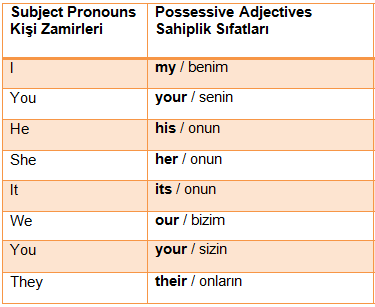
Aitlik anlamı verirler,ancak arkalarından getirilecek bir isim ya da isim grubuyla birlikte kullanılmak zorundadırlar.
ÖRNEK 😀
  • Have you taken your new torch with you?

(Sen yanına yeni meşaleni aldın mı?)

‘Possessive adjective’ler “possessive” “s” yapısının verdiği anlamı verirler.
ÖRNEK 😀
  • It is John‘s book. = It is his book. (O, onun-John’un- kitabı.)
  • They are my friends’ bikes. = They are their bikes.

         (Onlar, onların-benim arkadaşlarımın- bisikletleri.)

Yukarıdaki cümlede olduğu gibi, sözcük ‘s’ kullanılarak çoğul yapılmışsa, aitlik anlamı vermek için sadece üstten kesme işareti (apostrophe) kullanılır.
Bazen ‘the’ article’ı ‘my, your’ gibi ‘possessive adjective’lerin yerine kullanılabilir.
ÖRNEK 😀
  • A stone hit me on the head while I was passing by children’s playground.

(Çocukların oyun bahçesinden geçiyorken başıma taş çarptı.)

  • One of my friends had a terrible pain in the stomach yesterday.

(Arkadaşlarımın birisinin dün karnında berbat-kötü bir ağrı vardı.)

One’s ve whose yapıları da sahiplik yapılarıdır.
ÖRNEK 😀
  • One has an obligation to one’s friends. (Birinin arkadaşlarına zorunluluğu var.)
  • Whose book is this? (Bu kimin kitabı?)
Sahiplik sıfatları “the, a/an, this” gibi yapılarla kullanılmaz.
ÖRNEK 😀
  • I have lost my pen. (NOT …the my pen) (Ben kalemimi kaybettim.)
Önüne geldiği nesnenin kime ait olduğunu belirten iyelik sıfatlarıdır. İsim veya isim gruplarını niteler, tek başlarına anlamı yoktur. İyelik belirten ‘s’ ekinin verdiği anlamı verir. Bu ifadelerle ilgili soru sormak gerekiyorsa soru kelimesi olarak ‘whose’ kullanılır.
ÖRNEK 😀
  • James has decorated his new house in such a way that its style charms everyone.

          (James yeni evini, tarzını herkesi büyüleyecek şekilde dekore etti.)

  • Peter and Sarah have decided to get married in the summer and they think that their wedding will be an unforgettable one.

(Peter ve Sarah, yazın evlenmeye karar verdiler ve onlar düğünlerinin unutulmaz bir düğün olacağını düşünüyorlar.)

  • My friends and I are working for a charity and we donate some of our pocket money there.

(Benim arkadaşlarım ve ben bir hayırsever kurumu için çalışıyoruz ve bizim  poşet paralarımızın bazılarını bağışlıyoruz.)

Bir şeyin sözü geçen kişiye ait olduğunu vurgulamak için possessive adjective’lerden sonra “own” kelimesi kullanılabilir. ‘own’ of ile beraber sahiplik anlamı vermek için de kullanılır.
ÖRNEK 😀
  • I don’t need your trekking equipment; I’ve brought my own rope and helmet.

(Senin yürüyüş ekipmanına ihtiyacım yok; ben kendi ipimi ve miğferimi aldım.)

  • You can’t find the chart in this computer as Mike wrote it on his own laptop.

(Mike onu kendi bilgisayarında yazdığı için sen bu bilgisayarda çizelgeyi bulamazsın.)

  • Dora has always longed for a house of her own/ her own house.

(Dora genellikle kendi evini özledi.) 

Bir kişinin bir eylemi yardımsız veya yalnız başına yaptığını vurgulamak için ‘on + possessive adjective + own’ kalıbı kullanılır.
ÖRNEK 😀
  • I can’t understand why she likes having a holiday on her own. (alone – by herself)

(Ben onun tek başına tatile gitmeyi neden sevdiğini anlamıyorum.)

  • It was a real success for the kids to clean the whole garage on their own. (without help – by themselves)

(Bütün garajı yardım almadan temizlemek çocuklar için gerçek başarıydı.)

The post Possessive Adjectives appeared first on İngilizceyi Severek Öğren.

]]>
https://learnenglishfondly.com/possessive-adjectives-2/feed/ 0