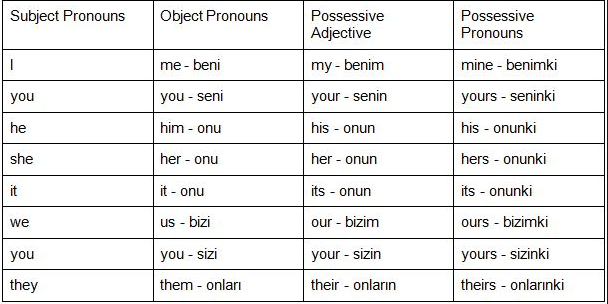
The car in the front is mine. (Öndeki araba benim-benimki.) There are many keys here. Which of these are yours? (Burada bir çok anahtar var. Seninki bunlardan hangisi?) a former colleague of mine (benim eski bir meslektaşım) an old friend of hers (onun eski bir arkadaşı) ➡ I met another colleague …
The post Possessive Pronouns appeared first on İngilizceyi Severek Öğren.
]]>

- The car in the front is mine. (Öndeki araba benim-benimki.)
- There are many keys here. Which of these are yours? (Burada bir çok anahtar var. Seninki bunlardan hangisi?)
- a former colleague of mine (benim eski bir meslektaşım)
- an old friend of hers (onun eski bir arkadaşı)
 I met another colleague of … yesterday. (Ben dün onun başka bir meslektaşı ile karşılaştım.)
a) hers (doğru) b) her (yanlış)
- Whose book is this? (Bu kimin kitabı?)
- Whose is this book? (Bu kitap kimin?)
- It’s important to have a belief of one’s own. (NOT ……of one’s) (Birisinin bir inanca sahip olması önemli.)
- I’ve eaten my fish and the cat has eaten its fish too. (NOT ……and the cat has eaten its.) (Ben balığımı yedim ve kedi de kendi balığını yedi.)
- A: My bike is broken. Can I borrow yours? (Benim bisikletim kırık. Seninkini ödünç alabilir miyim?)
B: Why don’t you ask Dan? (Neden Dan’a sormuyorsun?)
A: I can’t use his as it is too big. (O çok büyük olduğu için ben onunkini kullanamıyorum.)
B: Ok. I can give you mine as long as you bring it back before dinner. (Tamam. Onu akşam yemeğinden önce geri getirdiğin müddetçe benimkini sana verebilirim.)
- Casie is a neighbour of James’./She is a neighbour of his. (Casie, onun bir komşusu.)
- Bob and Patrick called a friend of theirs to ask for money. (Bob ve Patrick para istemek için onların bir arkadaşını çağırdı.)
- At the end of the term we went on a picnic with a teacher of ours and had quite a nice time together. (Dönemin sonunda bizim bir öğretmenimizle pikniğe gittik ve birlikte oldukça güzel zaman geçirdik.)
- What do you think of this new haircut of mine? (Benim bu yeni saç kesimim hakkında ne düşünüyorsun?)
- My aunt showed me a few photographs of me, which she took in her own house. (Halam bana kendi evinde çektiği benim birkaç fotoğrafımı gösterdi.)
- I showed my aunt some of the photographs of mine when I went to Long Lead. (Halama Long Lead’e gittiğim zaman çektiğim bazı fotoğraflar gösterdim.)
- The soldier was wounded on the head.
- I suddenly turned back when someone tapped me on the shoulder.
The post Possessive Pronouns appeared first on İngilizceyi Severek Öğren.
]]>SIMPLE PRESENT TENSE (GENİŞ ZAMAN) “Simple Present Tense” geniş zamanı ifade eder. Sürekli yaptığımız eylemleri, genel gerçek ifadeleri anlatır. OLUMLU I save money. ( Ben para biriktiririm.) YOU save money. ( Sen para biriktirirsin.) WE save money. ( Biz para biriktiririz.) THEY save money. ( Onlar para biriktirirler.) NOT: Simple Present Tense’de “ I, …
The post SIMPLE PRESENT TENSE appeared first on İngilizceyi Severek Öğren.
]]>SIMPLE PRESENT TENSE (GENİŞ ZAMAN)
“Simple Present Tense” geniş zamanı ifade eder. Sürekli yaptığımız eylemleri, genel gerçek ifadeleri anlatır.
OLUMLU
I save money. ( Ben para biriktiririm.)
YOU save money. ( Sen para biriktirirsin.)
WE save money. ( Biz para biriktiririz.)
THEY save money. ( Onlar para biriktirirler.)
NOT: Simple Present Tense’de “ I, YOU, WE ve THEY” özneleri ile birlikte fiilin birinci hali yani yalın hali kullanılır.
*** HE saves money. (O para biriktirir.)
SHE saves money. ( O para biriktirir.)
IT saves money. (O para biriktirir.)
NOT: “HE,SHE ve IT” özneleri ile fiile “-s,-es,-ies” takıları gelir.
OLUMSUZ
I don’t save money. ( Ben para biriktirmem.)
YOU don’t save money. (Sen para biriktirmezsin.)
HE doesn’t save money. (O para biriktirmez.)
SHE doesn’t save money. ( O para biriktirmez.)
IT doesn’t save money. (O para biriktirmez.)
WE don’t save money. (Biz para biriktirmeyiz.)
YOU don’t save money. ( Siz para biriktirmezsiniz.)
THEY don’t save money. ( Onlar para biriktirmezler.)
NOT: Olumsuz cümlelerde olumsuzluk eki NOT kullanılmak zorundadır ve DEĞİL anlamına gelir. Yardımcı fiil ile “DO NOT(DON’T)” şekinde kullanılır. “ I,YOU, WE ve THEY” öznelerinden sonra DO yardımcı fiili ve fiilin birinci hali kullanılır. “HE,SHE ve IT” öznelerinden sonra ise “DOES NOT(DOESN’T)” yardımcı fiili ile fiilin birinci hali kullanılır.
SORU
DO I save money ?
DO you save money ?
DO we save money ?
DO they save money ?
DOES he save money ?
DOES she save money ?
DOES it save money ?
NOT: Soru kalıplarında ise DO ve DOES başa gelir, sonra özne ve fiilinin birinci hali gelir.
TIME EXPRESSIONS FREQUENTLY USED IN SIMPLE PRESENT TENSE
( SIMPLE PRESENT TENSE’DE KULLANILAN SIKLIK ZARFLARI)
always > her zaman
almost always/nearly always > neredeyse her zaman
usually > genellikle
generally > genellikle
often > sık sık
frequently > sık sık
sometimes > bazen
occasionally > ara sıra
seldom > nadiren
rarely > nadiren
scarcely > neredeyse, hemen hemen
scarcely ever > hemen hemen hiç
barely > ancak, zar zor
ever > hiç
not ever > hiçbir zaman
never > asla
almost never > neredeyse hiç
at times > bazen, zaman zaman
once in a while > ara sıra, bazen
from time to time > zaman zaman
now and then > bazen, ara sıra
every day/week/month/summer … > her gün/ her hafta/ her ay/ her yaz
once/twice … a month/ a year … > ayda bir kez/iki kez yılda bir kez/ iki kez
at the weekends/on weekends > haftasonları
on Mondays/Sundays … > her pazartesi / her pazar
on weekdays > haftaiçileri
in the mornings/at nights … > sabahları/geceleri
every two days/every three weeks … > iki günde bir/ üç haftada bir
- Alışkanlıklar, yinelenen eylemler:
*During weekdays, I try to get an eight-hour sleep so that I can feel energetic at work.
( Hafta boyunca, ben işte kendimi enerjik hissedebilmem için sekiz saat uyku almayı denerim. )
*As a teacher, Semra always has extra work to do at home because she prepares lesson plans for the next day.
( Bir öğretmen olarak, Semra gelecek günün ders planlarını hazırladığı için genellikle evde daha çok çalışır. )
- Genellemeler, doğa kanunları, evrensel gerçekler:
*Hurricanes occur when the warm air from the surface of the ocean rises and meets the cooler air.
( Okyanusun yüzeyinden çıkan sıcak hava yükseldiğinde ve soğuk havayla birleştiğinde
kasırgalar meydana gelir. )
*Trees grow more quickly when they are young.
( Ağaçlar gençken daha hızlı büyür. )
- Geçerliliği sürekli ve kalıcı olan durum veya eylemler:
*Brian lives in a modest house although he earns quite a lot of money.
( Brian oldukça çok para kazanmasına rağmen gösterişsiz bir evde yaşıyor. )
*Harrods, the famous shopping mall in Britain, sells a large variety of goods.
( Britanya’da ünlü bir alışveriş merkezi olan Harrods çok çeşit ürün satar. )
- Eylem içermeyip durum bildiren fiillerle “-ing” eki kullanılmadan oluşturulan şimdiki zaman ifadesi:
*Serkan doesn’t know how to use the fax machine so he needs your help.
( Serkan faks makinesinin nasıl kullanıldığını bilmiyor bu yüzden yardımına ihtiyacı
Var. )
*She wants to ask a question but she doesn’t want to interrupt him now.
( O bir soru sormak istiyor ama şimdi onun sözünü kesmek istemiyor. )
- Haber başlıkları:
*Germany beats Argentina in the semi finals of the 2010 World Cup.
( Almanya 2010 Dünya Kupası’nın semi finallerinde Arjantina’yı yendi. )
*Prime Minister attends a special ceremony and makes a speech there.
- Kitap, film özetleri; öykü, fıkra anlatımı ve spor yorumları yaparken kullanılır:
*One day, the princess comes to the palace and comes together to her father.
( Bir gün prenses saraya gelir ve babasına kavuşur.)
*Messi kicks the ball and scores the goal of his team.
( Messi topa vurur ve takımına gol kazandırır. )
- Performative verbs ( accept, acknowledge, assume, believe, deny, hope,
İnform, promise, think…) ile oluşturulan cümleler ile kullanılır :
*I believe in faeries. ( Perilere inanırım. )
*I hope you won’t expect results immediately. ( Ben senin sonuçları hemen beklemeyeceğini umut ediyorum. )
USE OF FREQUENCY ADVERBS IN SIMPLE PRESENT TENSE
(SIMPLE PRESENT TENSE’DE SIKLIK ZARFLARININ KULLANIMI )
- Bir eylemin hangi sıklıkta yapıldığını öğrenmek istiyorsak “How often” sorusunu eyleme sormamız gerekir.
*Mary is always in charge. ( Mary her zaman sorumludur. )
*I never promise anybody anything. ( Ben asla birisine söz vermem. )
- Sıklık zarfları olumlu cümlede genellikle esas fiilden önce özne ile fiil arasında kullanılır. Ancak bu zarflar “be (am,is,are)” fiilinden sonra kullanılır.
*Our teacher usually lets us free. ( Öğretmenimiz bizi genellikle serbest bırakır. )
*Elena is sometimes pessimistic about the future of the company due to the economic crisis.
(Elena, ekonomik krizden dolayı şirketin geleceği konusunda bazen kötümserdir. )
- Fakat “be” fiili olumsuz yapıda ise kullanım değişebilir.
*My sister sometimes isn’t pleased with surprises.
( Kız kardeşim bazen sürprizlerden memnun olmaz. )
ÇOK ÖNEMLİ
Olumsuz cümlede her zaman “always” olumsuz belirten
ekten sonra gelmelidir.
*First impressions aren’t always correct. ( İlk izlenimler her zaman doğru değildir. )
- “Usually, normally, often, frequently, sometimes ve occasionally” , cümlelerin başında veya sonunda yer alabilir. Ancak, “always, never, rarely ve seldom” genellikle cümle başında veya sonunda yer almaz.
*Sometimes I enjoy playing computer games especially after a hard day.
( Bazen ben özellikle yoğun bir günün ardından bilgisayar oyunları oynamaya bayılırım. )
- “Frequently, sometimes, occasionally” olumsuz yardımcı fiilden önce gelmelidir.
*He sometimes doesn’t feel like going to work. ( feel like= wish, want )
( O bazen işe gitmek istemez. )
- “Usually, generally, often” olumsuz yardımcı fiilden önce ya da sonra gelebilir.
*My mother doesn’t often go shopping herself; instead, she prefers shopping online.
( Annem kendi kendine alışverişe gitmez, bunun yerine internetten alışveriş yapmayı tercih eder.)
- “Never, seldom, rarely, hardly ever” olumsuz anlam taşırlar. Bu zarflar olumlu fiil yapısıyla kullanılırlar ama cümlenin anlamını olumsuz yaparlar.
*My son never makes his bed, which always drives me crazy. ( Oğlum asla yatağını düzeltmez, ki bu da her zaman beni çıldırtır. )
ÇOK ÖNEMLİ
Olumsuz anlam taşıyan zarflar, cümle başında yer alırsa
cümlenin devrik yapılması zorunludur.
** Rarely do I watch football matches.
( Ben nadiren futbol maçlarını izlerim. )
**Never does Smith show tolerance to his employees if anything goes wrong.
( Smith, eğer bir şeyler yanlış giderse çalışanlarına asla tolerans göstermez. )
The post SIMPLE PRESENT TENSE appeared first on İngilizceyi Severek Öğren.
]]>