One, ones “Do you need a pen ?” “No, thanks. I already have one.” I prefer light colours to dark ones. The shopkeeper showed me two T-shirts and I bought the one with some flower patterns on. The students in class B have got much better scores than the ones in C. The small buildings …
The post Substitution About Pronouns appeared first on Learn English Fondly.
]]>One, ones

- “Do you need a pen ?” “No, thanks. I already have one.”
- I prefer light colours to dark ones.
- The shopkeeper showed me two T-shirts and I bought the one with some flower patterns on.
- The students in class B have got much better scores than the ones in C.
- The small buildings over there belong to the staff but those large ones are where the administrators stay.
- “I would like to try that shirt on.” “Which one?” “The blue one.”
- “Those students in the back row are from the States, but the ones in the front line are from Canada.”
- Don’t make a sudden decision to work in that company; you deserve a better one with your qualifications.
- The bowl was so small for the salad she made that she had to use two large ones to serve it.
- Don’t insist on answering all the questions in this book; those ones in the worksheet will be enough for revision.
- The band that performed the last in the contest was also the best (one).
- Which (one) would you like to buy out of these two dresses? I will buy the black one if you buy the other (one).
- Please, don’t wear this pink tie; get another (one).
- The one who is standing over there is our landlady.
- Dolores has filed the ones which belong to past year’s clients.
That of / Those of
- I can’t imagine a greater life than that of a teacher. (… than the life of a teacher)
- We should admit that the responsibilities of mothers are far more serious than those of fathers. (the responsibilities of fathers)
One of
- one of his books
- one of the/my/those birds (NOT one of birds)
- One of the cars in the parking lot has been sold.
- One of my classmates was awarded a scholarship in Canada.
- İstanbul is known as one of the most beautiful places not only in Europe but also in the whole world.

- Why don’t you ask one of the crew?
One or it
- I have to get a ticket to travel on public buses but I don’t know where I can get one. .)
- Take this card and don’t lose it; or else, you won’t be allowed to enter there.
- I haven’t got a calculator and I need one for the calculus class.
BUT
- “Have you seen my calculator around here?” “Yes, I’ve just seen it on your desk.”
The post Substitution About Pronouns appeared first on Learn English Fondly.
]]>Object Pronouns mean article of pronouns. Object pronouns replace the noun which is in case of object in the sentence. I bought her a birthday present. I bought a birthday present for her. You can take your jacket off if you like. You can take off your jacket if you …
The post OBJECT PRONOUNS appeared first on Learn English Fondly.
]]>Object Pronouns mean article of pronouns. Object pronouns replace the noun which is in case of object in the sentence.
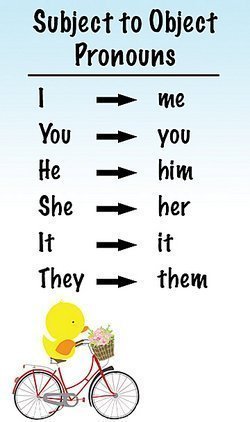
- I bought her a birthday present.
- I bought a birthday present for her.
- You can take your jacket off if you like.
- You can take off your jacket if you like.
- My sister is nearly as tall as me.
- I can run faster than him.
- My brother is as handsome as I am.
- Nobody but her would do such a crazy thing. (More formal: Nobody but she …)
- Everybody agreed except (for) me. (NOT … except I)
a) object pronoun + that (informal)
FOR EXAMPLE
- It was him that rescued the kids.
b) subject pronoun + who (formal)
FOR EXAMPLE
- It is I who need your advice.
- It was he who rescued the kids.
- He was the person/ the one who rescued the kids.
- It is for her to decide (NOT It is for she to decide).
- She was carrying a bag with thousands of dollars in (it).
- The cake was too beautiful to eat. (NOT …too beautiful to eat it)
Instead of nouns or noun groups which are in case of object in the sentence:
FOR EXAMPLE
- I saw Felicia crying yesterday but I didn’t ask her the reason.
- The girls in the school basketball team played very well and the coach thanked them for their great effort.
- Everything was arranged for the summit but the chairman postponed it to the following week.
When you want to use pronoun after prepositions:
FOR EXAMPLE
- Caroline is my best friend so please don’t talk behind her, at least when you are with me.
At structures of comparative that adjectives and adverbs are used:
FOR EXAMPLE
- I don’t speak English as fluently as him because he has been to Britain several times.
- The neighbours next door are a lot noisier than us as they have got three little children.
- My brother is more stubborn than I am.
- The Jenkins bought a bigger house than we did.
When it is used independently, not be in a sentence:
FOR EXAMPLE
- Alp: I didn’t like the film much.
Beril: Me, neither.
- Nilly: Who was shouting in the room yesterday?
Bruce: Him, not us.
- Who has left the room in such a mess?
I haven’t. She has.
When ‘it’ pronoun is used as ‘object pronoun’, it may be used in pursuit of verbs such as ‘love’, ‘hate’ that express emotion:
FOR EXAMPLE
- My father likes it that our family comes together on special occasions.
- Ahmet hates it when somebody criticizes his ambition in business.
In the usage “find / make / think… + it + adjective”:
FOR EXAMPLE
- When Evelyn went to Toronto for the first time, she found it hard to adapt to the city life.
- Only two of us left the hall earlier because the concert was quite boring.
- Sam sent her CV to several companies but only one of them called her for an interview.
The post OBJECT PRONOUNS appeared first on Learn English Fondly.
]]>TO BE ‘TO BE’ is basic verb that we use when we want to qualify objects around us and specify their properties, locations. When you set up a sentence in English, a verb is always There is no sentence in which there is no verb. A verb cannot be seen at first glance like …
The post TO BE appeared first on Learn English Fondly.
]]>TO BE
- ‘TO BE’ is basic verb that we use when we want to qualify objects around us and specify their properties, locations. When you set up a sentence in English, a verb is always There is no sentence in which there is no verb.
- A verb cannot be seen at first glance like sentences ‘Mary is fat’ or ‘Jane is beautiful’ . These are noun and adjective verbs in Turkish grammar. However, there are no constructions such as noun and adjective verbs in English. So when we set up nouns and adjective clauses, we fill this void with verb ‘ to be’ .
- In short, ‘ TO BE’ specifies either the object or the object that characterizes the adjective. TO BE clauses aren’t definitely an action clauses. It cannot describe any structure that contains motion, acceleration.
- To be + adjective
John is handsome.
- To be + noun
Mary is a teacher.
- To be + there is no definitely verb
Now, let’s examine the distribution of TO BE auxiliary verbs according to their pronouns.
| NORMAL SPELLING | ABBREVIATION |
| I am | I’m |
| You are | You’re |
| He is | He’s |
| She is | She’s |
| It is | It’s |
| We are | We’re |
| They are | They’re |
EXAMPLES:
*She is my sister.
*His shoes are dirty.
*Tom is tired.
*Shops are closed.
*Jane is at home.
*I am 21 years old.
*The movie is wonderful.
*Karen’s eyes are green.
*It is Linda’s bag.
*They are in the kitchen.
QUESTIONS and NEGATIVES
When doing negative sentence, it is brought ‘not’ after the auxiliary verb. This pattern is the same all the time in English.
QUESTIONS
am ı…..?
are you…..?
is he…..?
is she…..?
is it…….?
are we…..?
are they……?
EXAMPLES:
*Is she my daughter ?
*Are his shoes dirty ?
*Is Tom tired ?
*Are shops closed ?
*Is Jane at home ?
NEGATIVES
It is used ‘not’ after the auxiliary verb to do negative the sentences made with ‘am-is-are’ auxiliary verbs.
I am not ( no abbreviation )
You are not ( aren’t )
He is not ( isn’t )
She is not ( isn’t )
It is not ( isn’t )
We are not ( aren’t )
They are not ( aren’t )
EXAMPLES:
She isn’t my daughter.
His shoes aren’t dirty.
Tom isn’t tired.
Shops aren’t closed.
Jane isn’t at home.
The post TO BE appeared first on Learn English Fondly.
]]>