Deprecated: Return type of Ai1wm_Recursive_Directory_Iterator::hasChildren($allow_links = true) should either be compatible with RecursiveDirectoryIterator::hasChildren(bool $allowLinks = false): bool, or the #[\ReturnTypeWillChange] attribute should be used to temporarily suppress the notice in /home/ceerenco/learnenglishfondly.com/wp-content/plugins/All-In-One-WP-Migration-With-Import-master/lib/vendor/servmask/iterator/class-ai1wm-recursive-directory-iterator.php on line 57

Deprecated: Return type of Ai1wm_Recursive_Directory_Iterator::rewind() should either be compatible with FilesystemIterator::rewind(): void, or the #[\ReturnTypeWillChange] attribute should be used to temporarily suppress the notice in /home/ceerenco/learnenglishfondly.com/wp-content/plugins/All-In-One-WP-Migration-With-Import-master/lib/vendor/servmask/iterator/class-ai1wm-recursive-directory-iterator.php on line 35

Deprecated: Return type of Ai1wm_Recursive_Directory_Iterator::next() should either be compatible with DirectoryIterator::next(): void, or the #[\ReturnTypeWillChange] attribute should be used to temporarily suppress the notice in /home/ceerenco/learnenglishfondly.com/wp-content/plugins/All-In-One-WP-Migration-With-Import-master/lib/vendor/servmask/iterator/class-ai1wm-recursive-directory-iterator.php on line 42

Deprecated: Return type of Ai1wm_Recursive_Extension_Filter::getChildren() should either be compatible with RecursiveFilterIterator::getChildren(): ?RecursiveFilterIterator, or the #[\ReturnTypeWillChange] attribute should be used to temporarily suppress the notice in /home/ceerenco/learnenglishfondly.com/wp-content/plugins/All-In-One-WP-Migration-With-Import-master/lib/vendor/servmask/filter/class-ai1wm-recursive-extension-filter.php on line 47

Deprecated: Return type of Ai1wm_Recursive_Extension_Filter::accept() should either be compatible with FilterIterator::accept(): bool, or the #[\ReturnTypeWillChange] attribute should be used to temporarily suppress the notice in /home/ceerenco/learnenglishfondly.com/wp-content/plugins/All-In-One-WP-Migration-With-Import-master/lib/vendor/servmask/filter/class-ai1wm-recursive-extension-filter.php on line 37

Deprecated: Return type of Ai1wm_Recursive_Exclude_Filter::getChildren() should either be compatible with RecursiveFilterIterator::getChildren(): ?RecursiveFilterIterator, or the #[\ReturnTypeWillChange] attribute should be used to temporarily suppress the notice in /home/ceerenco/learnenglishfondly.com/wp-content/plugins/All-In-One-WP-Migration-With-Import-master/lib/vendor/servmask/filter/class-ai1wm-recursive-exclude-filter.php on line 41

Deprecated: Return type of Ai1wm_Recursive_Exclude_Filter::accept() should either be compatible with FilterIterator::accept(): bool, or the #[\ReturnTypeWillChange] attribute should be used to temporarily suppress the notice in /home/ceerenco/learnenglishfondly.com/wp-content/plugins/All-In-One-WP-Migration-With-Import-master/lib/vendor/servmask/filter/class-ai1wm-recursive-exclude-filter.php on line 37

Deprecated: Return type of Ai1wm_Recursive_Newline_Filter::accept() should either be compatible with FilterIterator::accept(): bool, or the #[\ReturnTypeWillChange] attribute should be used to temporarily suppress the notice in /home/ceerenco/learnenglishfondly.com/wp-content/plugins/All-In-One-WP-Migration-With-Import-master/lib/vendor/servmask/filter/class-ai1wm-recursive-newline-filter.php on line 28

Deprecated: Return type of WPCF7_FormTag::offsetExists($offset) should either be compatible with ArrayAccess::offsetExists(mixed $offset): bool, or the #[\ReturnTypeWillChange] attribute should be used to temporarily suppress the notice in /home/ceerenco/learnenglishfondly.com/wp-content/plugins/contact-form-7/includes/form-tag.php on line 542

Deprecated: Return type of WPCF7_FormTag::offsetGet($offset) should either be compatible with ArrayAccess::offsetGet(mixed $offset): mixed, or the #[\ReturnTypeWillChange] attribute should be used to temporarily suppress the notice in /home/ceerenco/learnenglishfondly.com/wp-content/plugins/contact-form-7/includes/form-tag.php on line 528

Deprecated: Return type of WPCF7_FormTag::offsetSet($offset, $value) should either be compatible with ArrayAccess::offsetSet(mixed $offset, mixed $value): void, or the #[\ReturnTypeWillChange] attribute should be used to temporarily suppress the notice in /home/ceerenco/learnenglishfondly.com/wp-content/plugins/contact-form-7/includes/form-tag.php on line 516

Deprecated: Return type of WPCF7_FormTag::offsetUnset($offset) should either be compatible with ArrayAccess::offsetUnset(mixed $offset): void, or the #[\ReturnTypeWillChange] attribute should be used to temporarily suppress the notice in /home/ceerenco/learnenglishfondly.com/wp-content/plugins/contact-form-7/includes/form-tag.php on line 552

Deprecated: Return type of WPCF7_Validation::offsetExists($offset) should either be compatible with ArrayAccess::offsetExists(mixed $offset): bool, or the #[\ReturnTypeWillChange] attribute should be used to temporarily suppress the notice in /home/ceerenco/learnenglishfondly.com/wp-content/plugins/contact-form-7/includes/validation.php on line 129

Deprecated: Return type of WPCF7_Validation::offsetGet($offset) should either be compatible with ArrayAccess::offsetGet(mixed $offset): mixed, or the #[\ReturnTypeWillChange] attribute should be used to temporarily suppress the notice in /home/ceerenco/learnenglishfondly.com/wp-content/plugins/contact-form-7/includes/validation.php on line 117

Deprecated: Return type of WPCF7_Validation::offsetSet($offset, $value) should either be compatible with ArrayAccess::offsetSet(mixed $offset, mixed $value): void, or the #[\ReturnTypeWillChange] attribute should be used to temporarily suppress the notice in /home/ceerenco/learnenglishfondly.com/wp-content/plugins/contact-form-7/includes/validation.php on line 98

Deprecated: Return type of WPCF7_Validation::offsetUnset($offset) should either be compatible with ArrayAccess::offsetUnset(mixed $offset): void, or the #[\ReturnTypeWillChange] attribute should be used to temporarily suppress the notice in /home/ceerenco/learnenglishfondly.com/wp-content/plugins/contact-form-7/includes/validation.php on line 139

Deprecated: Constant FILTER_SANITIZE_STRING is deprecated in /home/ceerenco/learnenglishfondly.com/wp-content/plugins/wordpress-seo/src/conditionals/third-party/elementor-edit-conditional.php on line 22

Deprecated: Constant FILTER_SANITIZE_STRING is deprecated in /home/ceerenco/learnenglishfondly.com/wp-content/plugins/wordpress-seo/src/conditionals/third-party/elementor-edit-conditional.php on line 28

Warning: Cannot modify header information - headers already sent by (output started at /home/ceerenco/learnenglishfondly.com/wp-content/plugins/contact-form-7/includes/form-tag.php:8) in /home/ceerenco/learnenglishfondly.com/wp-includes/feed-rss2.php on line 8
pronouns arşivleri | Learn English Fondly https://learnenglishfondly.com Learn English Fondly,Easily,Quickly Wed, 04 Sep 2019 12:20:00 +0000 en-US hourly 1 https://wordpress.org/?v=6.0.11 Substitution About Pronouns https://learnenglishfondly.com/en/substitution-about-pronouns/ https://learnenglishfondly.com/en/substitution-about-pronouns/#respond Wed, 04 Sep 2019 12:19:40 +0000 https://learnenglishfondly.com/?p=2302 Learn English Fondly Learn English Fondly - Learn English Fondly,Easily,Quickly

One, ones “Do you need a pen ?” “No, thanks. I already have one.”  I prefer light colours to dark ones. The shopkeeper showed me two T-shirts and I bought the one with some flower patterns on. The students in class B have got much better scores than the ones in C.  The small buildings …

The post Substitution About Pronouns appeared first on Learn English Fondly.

]]>
Learn English Fondly Learn English Fondly - Learn English Fondly,Easily,Quickly

One, ones

‘One’ is used instead of countable singular noun, “ones” is used instead of countable plural noun.
FOR EXAMPLE :mrgreen:
  • “Do you need a pen ?” “No, thanks. I already have one.” 
  • I prefer light colours to dark ones.
  • The shopkeeper showed me two T-shirts and I bought the one with some flower patterns on.
  • The students in class B have got much better scores than the ones in C. 
  • The small buildings over there belong to the staff but those large ones are where the administrators stay. 
If it needs to be indicated nouns that ‘one’ or‘ones’ pronouns substituting to noun refer to or to be remarked these(for example, with a “relative clause”), ‘the’ is used in front of them.
FOR EXAMPLE :mrgreen:
  • “I would like to try that shirt on.” “Which one?” “The blue one.” 
  • “Those students in the back row are from the States, but the ones in the front line are from Canada.” 
One/ones” isn’t used after “a/an, my/your … etc., some, any, both” and numbers. But ‘one’, ‘ones’ may be used if there is a adjective between them.
FOR EXAMPLE :mrgreen:
  • Don’t make a sudden decision to work in that company; you deserve a better one with your qualifications. 
  • The bowl was so small for the salad she made that she had to use two large ones to serve it. 
“One/ones” may be used after “the, this, that, these, those, each, another, which” or superlative adjective; however,it is not obligatory.
FOR EXAMPLE :mrgreen:
  • Don’t insist on answering all the questions in this book; those ones in the worksheet will be enough for revision. 
  • The band that performed the last in the contest was also the best (one)
  • Which (one) would you like to buy out of these two dresses? I will buy the black one if you buy the other (one)
  • Please, don’t wear this pink tie; get another (one)
These pronouns are used extensively with the usage ‘relative clause’ as well.
FOR EXAMPLE :mrgreen:
  • The one who is standing over there is our landlady. 
  • Dolores has filed the ones which belong to past year’s clients. 

That of / Those of

These two usages can be used in order to not repeat again a noun which was mentioned in the sentence before. “That of” is used instead of a singular noun, “those of” is used instead of a plural noun.

FOR EXAMPLE :mrgreen:
  • I can’t imagine a greater life than that of a teacher. (… than the life of a teacher) 
  • We should admit that the responsibilities of mothers are far more serious than those of fathers. (the responsibilities of fathers)

One of

A plural noun is used after the usage “one of”. Using a determiner as “the, my, those” in front of this plural noun is obligatory. It is necessary to pay attention to the subject-verb harmony after the usage ‘one of’. The verb after this usage must be singular.
FOR EXAMPLE :mrgreen:
  • one of his books 
  • one of the/my/those birds (NOT one of birds)
  • One of the cars in the parking lot has been sold. 
  • One of my classmates was awarded a scholarship in Canada. 
  • İstanbul is known as one of the most beautiful places not only in Europe but also in the whole world. 
“One of” is sometimes used with a singular noun. But this singular noun is a noun making a reference to a group.
FOR EXAMPLE 😀
  • Why don’t you ask one of the crew

One or it

“One” is used to mention generally an object, “it” is used to make a reference to a certain object described before.
FOR EXAMPLE :mrgreen:
  • I have to get a ticket to travel on public buses but I don’t know where I can get one. .)
  • Take this card and don’t lose it; or else, you won’t be allowed to enter there. 
  • I haven’t got a calculator and I need one for the calculus class. 
               BUT
  • “Have you seen my calculator around here?” “Yes, I’ve just seen it on your desk.” 

The post Substitution About Pronouns appeared first on Learn English Fondly.

]]>
https://learnenglishfondly.com/en/substitution-about-pronouns/feed/ 0
Pronouns Exercise https://learnenglishfondly.com/en/pronouns-exercise/ https://learnenglishfondly.com/en/pronouns-exercise/#respond Sat, 17 Aug 2019 13:59:22 +0000 https://learnenglishfondly.com/?p=2234 Learn English Fondly Learn English Fondly - Learn English Fondly,Easily,Quickly

The post Pronouns Exercise appeared first on Learn English Fondly.

]]>
Learn English Fondly Learn English Fondly - Learn English Fondly,Easily,Quickly

The post Pronouns Exercise appeared first on Learn English Fondly.

]]>
https://learnenglishfondly.com/en/pronouns-exercise/feed/ 0
Reflexive Pronouns Exercise https://learnenglishfondly.com/en/reflexive-pronouns-exercise/ https://learnenglishfondly.com/en/reflexive-pronouns-exercise/#respond Sat, 17 Aug 2019 13:05:54 +0000 https://learnenglishfondly.com/?p=2229 Learn English Fondly Learn English Fondly - Learn English Fondly,Easily,Quickly

The post Reflexive Pronouns Exercise appeared first on Learn English Fondly.

]]>
Learn English Fondly Learn English Fondly - Learn English Fondly,Easily,Quickly

The post Reflexive Pronouns Exercise appeared first on Learn English Fondly.

]]>
https://learnenglishfondly.com/en/reflexive-pronouns-exercise/feed/ 0
Reflexive Pronouns https://learnenglishfondly.com/en/reflexive-pronouns/ https://learnenglishfondly.com/en/reflexive-pronouns/#respond Fri, 16 Aug 2019 11:19:54 +0000 https://learnenglishfondly.com/?p=2220 Learn English Fondly Learn English Fondly - Learn English Fondly,Easily,Quickly

It is used in the cases which people are affected by their work themselves, in other words, in the cases which subject and object are the same person. Look at your arm. You have painted yourself. I cut myself while I was peeling potatoes for dinner. Talking to oneself is the first sign of madness. …

The post Reflexive Pronouns appeared first on Learn English Fondly.

]]>
Learn English Fondly Learn English Fondly - Learn English Fondly,Easily,Quickly

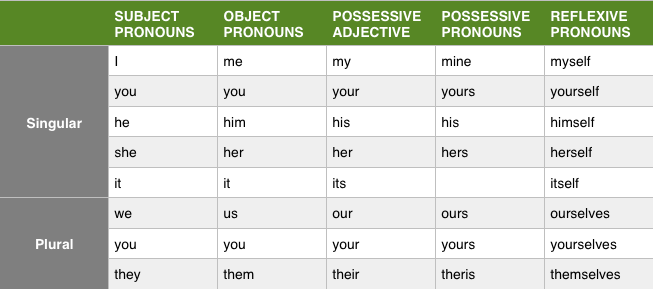
It is used in the cases which people are affected by their work themselves, in other words, in the cases which subject and object are the same person.

FOR EXAMPLE 😀
  • Look at your arm. You have painted yourself.
  • I cut myself while I was peeling potatoes for dinner.
  • Talking to oneself is the first sign of madness.

Reflexive pronouns can apostrophize to possessive statements and objects as well.

FOR EXAMPLE 😀
  • Her stories are all about herself.

‘Object pronoun’ is used after a preposition reporting place, not ‘reflexive pronoun’.

FOR EXAMPLE 😀
  • I didn’t have any money with … . 

a) her (true)   b) myself (false)

  • She didn’t see the car behind … while she was parking. 

a) her (true)   b) herself (false)

But, reflexive pronoun is used in cases which there is a possibility of referring to someone else.
FOR EXAMPLE:-D
  • He is very angry with himself

(It should be noted that the act of anger returns to the subject by using reflexive pronouns because there is a possibility of being angry with someone else in this sentence.)

Reflexive pronoun structures can be used in sentence at different places to emphasize at meaning “my own self, me myself and I / in the flesh, in person”.

FOR EXAMPLE 😀
  • I myself want to see the manager. 
  • They talked to the doctor himself

Reflexive pronoun structures can be used at meaning “alone” or “without help from anyone else” in form of”by+reflexive pronoun”. This meaning can be given with the usage of ‘on my/his/their own’.

FOR EXAMPLE 😀
  • The old woman lives by herself in an enormous house. 
  • Hillary was only four but she wrote her name all by herself
  • It’s a big garden, but we do all the gardening (by) ourselves
  • Little Tom made that cake all by himself

There are some idioms used with ‘reflexive pronouns’. Please, examine the examples below.

FOR EXAMPLE 😀
  • I hope the fanatic supporters behave themselves this time. (stand smarter)
  • Please help yourself to the food, won’t you? (When someone is asked to buy from foods and drinks, it is used at meaning “go ahead”.)
  • Please make yourself at home. (It is used when someone is invited and told to comfort oneself as if one self home.)

Reflexive pronouns can be used in order to emphasize.

FOR EXAMPLE 😀
  • Do it yourself
  • The house itself is nice, but the garden is very small. 

There is not reflexive structure describing possessive. Instead, “my own, your own, his own etc.” usages are used.

FOR EXAMPLE 😀
  • I only wash my own clothes. (NOT …myself’s clothes)

The verbs as “wash, dress, shave” are not used with reflexive pronouns in English.

FOR EXAMPLE:-D
  • I shave on Mondays. (NOT …shave myself)

However, reflexive pronouns can be used when it need to clear who the action is made by.

FOR EXAMPLE 😀
  • My son is old enough to dress himself

Those are other some verbs which are not used with reflexive pronouns:

FOR EXAMPLE 😀
  • All of a sudden, one of the windows opened
  • Her latest book is selling well.
  • You should try to concentrate
  • I feel funny. (NOT I feel myself funny.) 

“Reflexive pronouns” are used in the sentences that its subject and its object are same. It indicates that the subject is influenced by his/her work.

FOR EXAMPLE 😀
  • After years of experience, I have taught myself to tolerate people. 
  • As we were waiting for the results, we all prepared ourselves for the worst.
Reflexive pronouns are not used with some verbs as “feel, dress, get up, concentrate, adapt, remember, stand up, wake up, move, hurry, get married, get tired, wash, shave, meet, rest”.
FOR EXAMPLE 😀
  • I feel nervous.
  • Hande couldn’t concentrate on the film due to the noise. 
However, above verbs are used with reflexive pronouns so as to emphasize that the action is made with difficulty.
FOR EXAMPLE 😀
  • We were filled with joy when we saw our two-year old son dressed himself.

When it is used with ‘by’ preposition, it is emphasized that the action was made only by that person without help.

FOR EXAMPLE 😀
  • You should learn to get over troubles by yourself
  • It is not advisable to let little children play near the swimming pool by themselves

These pronouns can characterise both subject and object.

FOR EXAMPLE 😀
  • Grandad saw Atatürk himself in 1930. 
  • I talked to the children themselves; I didn’t complain to their parents. 

“Reflexive pronouns” can be used after a preposition.

FOR EXAMPLE 😀
  • She only thinks of herself
  • When her mind is too busy with something, Laura talks to herself

However, “reflexive pronouns” cannot be used, and “object pronouns” is used if the preposition in the sentence is used for locating.

FOR EXAMPLE 😀
  • Martha placed her handbag in front of her.
  • Please, don’t bring your cousin with you because she is too naughty. 
These pronouns are also used with below statements.

enjoy oneself / help oneself / be proud of oneself / take care of oneself / make oneself at home / behave oneself

FOR EXAMPLE 😀
  • I hope you will like the film. Enjoy yourself
  • Come on kids! Help yourselves to these delicious chocolate cookies! 

The post Reflexive Pronouns appeared first on Learn English Fondly.

]]>
https://learnenglishfondly.com/en/reflexive-pronouns/feed/ 0
Possessive Pronouns Exercise https://learnenglishfondly.com/en/possessive-pronouns-exercise/ https://learnenglishfondly.com/en/possessive-pronouns-exercise/#respond Wed, 07 Aug 2019 11:28:25 +0000 https://learnenglishfondly.com/?p=2177 Learn English Fondly Learn English Fondly - Learn English Fondly,Easily,Quickly

The post Possessive Pronouns Exercise appeared first on Learn English Fondly.

]]>
Learn English Fondly Learn English Fondly - Learn English Fondly,Easily,Quickly

The post Possessive Pronouns Exercise appeared first on Learn English Fondly.

]]>
https://learnenglishfondly.com/en/possessive-pronouns-exercise/feed/ 0
Subject and Object Pronouns Exercise https://learnenglishfondly.com/en/subject-and-object-pronouns-exercise/ https://learnenglishfondly.com/en/subject-and-object-pronouns-exercise/#respond Fri, 26 Jul 2019 18:25:38 +0000 https://learnenglishfondly.com/?p=2064 Learn English Fondly Learn English Fondly - Learn English Fondly,Easily,Quickly

The post Subject and Object Pronouns Exercise appeared first on Learn English Fondly.

]]>
Learn English Fondly Learn English Fondly - Learn English Fondly,Easily,Quickly

The post Subject and Object Pronouns Exercise appeared first on Learn English Fondly.

]]>
https://learnenglishfondly.com/en/subject-and-object-pronouns-exercise/feed/ 0
OBJECT PRONOUNS https://learnenglishfondly.com/en/object-pronouns-2/ https://learnenglishfondly.com/en/object-pronouns-2/#comments Tue, 23 Jul 2019 08:19:23 +0000 https://learnenglishfondly.com/?p=2049 Learn English Fondly Learn English Fondly - Learn English Fondly,Easily,Quickly

            Object Pronouns mean article of pronouns. Object pronouns replace the noun which is in case of object in the sentence. I bought her a birthday present. I bought a birthday present for her. You can take your jacket off if you like. You can take off your jacket if you …

The post OBJECT PRONOUNS appeared first on Learn English Fondly.

]]>
Learn English Fondly Learn English Fondly - Learn English Fondly,Easily,Quickly

            Object Pronouns mean article of pronouns. Object pronouns replace the noun which is in case of object in the sentence.
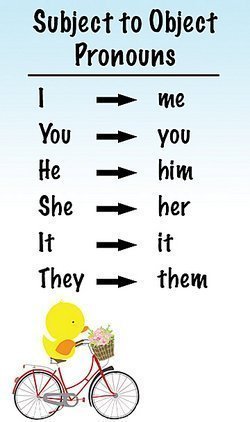
They are used as the object of the verb in the sentence. If there are two objects in the sentence, ‘object pronoun’ is used as in below example sentences.
FOR EXAMPLE 😀
  • I bought her a birthday present.
  • I bought a birthday present for her.
When many of ‘phrasal verbs’ are used with a object together, the object can be used both in the form of ‘verb+noun+preposition’ and in the form of ‘verb+preposition+noun’ .
FOR EXAMPLE 😀
  • You can take your jacket off if you like.
  • You can take off your jacket if you like.
After the usages of “as” and “than”, object pronouns are used in “informal” language.
FOR EXAMPLE 😀
  • My sister is nearly as tall as me.
  • I can run faster than him.
Subject pronouns are used in a “formal” language and auxiliary verb is used after these.
FOR EXAMPLE 😀
  • My brother is as handsome as I am.
After the usage of “but” (meaning of except), object pronouns are always used. The usage of subject pronouns is possible in more “formal” language before a verb.
FOR EXAMPLE 😀
  • Nobody but her would do such a crazy thing. (More formal: Nobody but she …)
We use object pronouns after the usage of except (for).
FOR EXAMPLE 😀
  • Everybody agreed except (for) me. (NOT … except I)
When relative clause is used after “it is …” or “it was…”, there are two possibilities:

a) object pronoun + that (informal)

FOR EXAMPLE 😀
  • It was him that rescued the kids.

b) subject pronoun + who (formal)

FOR EXAMPLE 😀
  • It is I who need your advice.
  • It was he who rescued the kids.
We can give the same meaning by using a different usage so as to avoid being more formal or more informal.
FOR EXAMPLE 😀
  • He was the person/ the one who rescued the kids.
A pronoun may sometimes be the subject of the usage of “infinitive-to” and clause, also may be the object of a verb or preposition. In such cases, object pronouns normally are used.
FOR EXAMPLE 😀
  • It is for her to decide (NOT It is for she to decide).
The personal pronouns after the ‘prepositions’ in the descriptive structures made with the words “have” and “with” can be removed from the sentence.
FOR EXAMPLE 😀
  • She was carrying a bag with thousands of dollars in (it).
If the object of infinitive-to‘ usage is just mentioned, object pronouns are not used at infinitive clauses.
FOR EXAMPLE 😀
  • The cake was too beautiful to eat. (NOT …too beautiful to eat it)
Essential points and clues about Object Pronouns
Instead of nouns or noun groups which are in case of object in the sentence:
FOR EXAMPLE 😀
  • I saw Felicia crying yesterday but I didn’t ask her the reason.
  • The girls in the school basketball team played very well and the coach thanked them for their great effort.
  • Everything was arranged for the summit but the chairman postponed it to the following week.
When you want to use pronoun after prepositions:
FOR EXAMPLE 😀
  • Caroline is my best friend so please don’t talk behind her, at least when you are with me.
At structures of comparative that adjectives and adverbs are used:
FOR EXAMPLE 😀
  • I don’t speak English as fluently as him because he has been to Britain several times.
  • The neighbours next door are a lot noisier than us as they have got three little children.
When ‘subject pronoun’ is used for the side made comparative, auxiliary verb must be used in pursuit of this.
FOR EXAMPLE 😀
  • My brother is more stubborn than I am.
  • The Jenkins bought a bigger house than we did.
When it is used independently, not be in a sentence:
FOR EXAMPLE 😀
  • Alp: I didn’t like the film much.

Beril: Me, neither.

  • Nilly: Who was shouting in the room yesterday?

Bruce: Him, not us.

If ‘subject pronoun’ is used in these usages, then auxiliary verb must be used.
FOR EXAMPLE 😀
  • Who has left the room in such a mess?

I haven’t. She has.

When ‘it’ pronoun is used as ‘object pronoun’, it may be used in pursuit of verbs such as ‘love’, ‘hate’ that express emotion:
FOR EXAMPLE 😀
  • My father likes it that our family comes together on special occasions.
  • Ahmet hates it when somebody criticizes his ambition in business.
In the usage “find / make / think… + it + adjective”:
FOR EXAMPLE 😀
  • When Evelyn went to Toronto for the first time, she found it hard to adapt to the city life.
Even if pronoun is in subjective (subject) case at situations which are expressed by being used “of”, ‘object pronoun’ must be used.
FOR EXAMPLE 😀
  • Only two of us left the hall earlier because the concert was quite boring.
  • Sam sent her CV to several companies but only one of them called her for an interview.

The post OBJECT PRONOUNS appeared first on Learn English Fondly.

]]>
https://learnenglishfondly.com/en/object-pronouns-2/feed/ 1