It is used in the cases which people are affected by their work themselves, in other words, in the cases which subject and object are the same person. Look at your arm. You have painted yourself. I cut myself while I was peeling potatoes for dinner. Talking to oneself is the first sign of madness. …
The post Reflexive Pronouns appeared first on Learn English Fondly.
]]>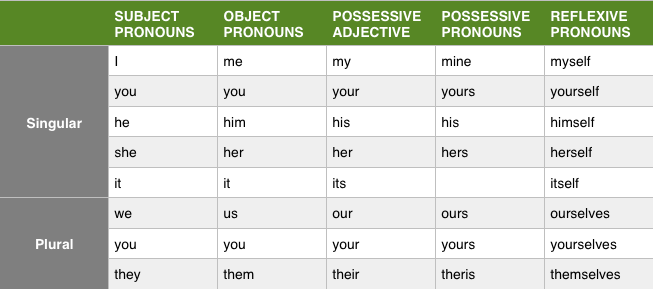
FOR EXAMPLEIt is used in the cases which people are affected by their work themselves, in other words, in the cases which subject and object are the same person.

- Look at your arm. You have painted yourself.
- I cut myself while I was peeling potatoes for dinner.
- Talking to oneself is the first sign of madness.
FOR EXAMPLEReflexive pronouns can apostrophize to possessive statements and objects as well.
- Her stories are all about herself.
FOR EXAMPLE‘Object pronoun’ is used after a preposition reporting place, not ‘reflexive pronoun’.
- I didn’t have any money with … .
a) her (true) b) myself (false)
- She didn’t see the car behind … while she was parking.
a) her (true) b) herself (false)
- He is very angry with himself.
(It should be noted that the act of anger returns to the subject by using reflexive pronouns because there is a possibility of being angry with someone else in this sentence.)
FOR EXAMPLEReflexive pronoun structures can be used in sentence at different places to emphasize at meaning “my own self, me myself and I / in the flesh, in person”.
- I myself want to see the manager.
- They talked to the doctor himself.
FOR EXAMPLEReflexive pronoun structures can be used at meaning “alone” or “without help from anyone else” in form of”by+reflexive pronoun”. This meaning can be given with the usage of ‘on my/his/their own’.
- The old woman lives by herself in an enormous house.
- Hillary was only four but she wrote her name all by herself.
- It’s a big garden, but we do all the gardening (by) ourselves.
- Little Tom made that cake all by himself.
FOR EXAMPLEThere are some idioms used with ‘reflexive pronouns’. Please, examine the examples below.
- I hope the fanatic supporters behave themselves this time. (stand smarter)
- Please help yourself to the food, won’t you? (When someone is asked to buy from foods and drinks, it is used at meaning “go ahead”.)
- Please make yourself at home. (It is used when someone is invited and told to comfort oneself as if one self home.)
FOR EXAMPLEReflexive pronouns can be used in order to emphasize.
- Do it yourself.
- The house itself is nice, but the garden is very small.
FOR EXAMPLEThere is not reflexive structure describing possessive. Instead, “my own, your own, his own etc.” usages are used.
- I only wash my own clothes. (NOT …myself’s clothes)
FOR EXAMPLE:-DThe verbs as “wash, dress, shave” are not used with reflexive pronouns in English.
- I shave on Mondays. (NOT …shave myself)
FOR EXAMPLEHowever, reflexive pronouns can be used when it need to clear who the action is made by.
- My son is old enough to dress himself.
FOR EXAMPLEThose are other some verbs which are not used with reflexive pronouns:
- All of a sudden, one of the windows opened.
- Her latest book is selling well.
- You should try to concentrate.
- I feel funny. (NOT I feel myself funny.)
FOR EXAMPLE“Reflexive pronouns” are used in the sentences that its subject and its object are same. It indicates that the subject is influenced by his/her work.
- After years of experience, I have taught myself to tolerate people.
- As we were waiting for the results, we all prepared ourselves for the worst.
- I feel nervous.
- Hande couldn’t concentrate on the film due to the noise.
- We were filled with joy when we saw our two-year old son dressed himself.
FOR EXAMPLEWhen it is used with ‘by’ preposition, it is emphasized that the action was made only by that person without help.
- You should learn to get over troubles by yourself.
- It is not advisable to let little children play near the swimming pool by themselves.
FOR EXAMPLEThese pronouns can characterise both subject and object.
- Grandad saw Atatürk himself in 1930.
- I talked to the children themselves; I didn’t complain to their parents.
FOR EXAMPLE“Reflexive pronouns” can be used after a preposition.
- She only thinks of herself.
- When her mind is too busy with something, Laura talks to herself.
FOR EXAMPLEHowever, “reflexive pronouns” cannot be used, and “object pronouns” is used if the preposition in the sentence is used for locating.
- Martha placed her handbag in front of her.
- Please, don’t bring your cousin with you because she is too naughty.
enjoy oneself / help oneself / be proud of oneself / take care of oneself / make oneself at home / behave oneself
- I hope you will like the film. Enjoy yourself!
- Come on kids! Help yourselves to these delicious chocolate cookies!
The post Reflexive Pronouns appeared first on Learn English Fondly.
]]>The Simple Past Tense, sometimes called the "Preterite", is used to talk about a completed action in a time before now. The Simple Past Tense is the basic form of past tense in English. The time of action can be in the recent past or the distant past and action duration is not important.
The post SIMPLE PAST TENSE appeared first on Learn English Fondly.
]]>The Simple Past Tense, sometimes called the “Preterite”, is used to talk about a completed action in a time before now. The Simple Past Tense is the basic form of past tense in English. The time of action can be in the recent past or the distant past and action duration is not important.
 SIMPLE PAST FORM
S(Subject) + V2 (The second state of the verb) + O(Object)
For Positive Sentences;
S(Subject) + V2(The second state of the verb) + O(Object)
FOR EXAMPLE
- I came to the home immediately.
- Jane Austen began to write the novel in her teenage years.
For Negative Sentences;
S(Subject) + did not (didn’t) + V1(The bare infinitive)
FOR EXAMPLE
- She went shopping yesterday, but she didn’t buy anything.
- I didn’t get up very early yesterday.
For Question Sentences;
DID + S(Subject) + V1(The bare infinitive)
FOR EXAMPLE
- Did the manager call me yesterday ?
- Did you go to the school two weeks ago ?
TIME EXPRESSIONS FREQUENTLY USED IN SIMPLE PAST TENSE
yesterday
ago
last week / year / month …
then
in 1998 / in the 14th century …
at the time
at that time
previously
in ancient times
in antiquity
when
whenever
while
after
before
until
as soon as
the moment
immediately after
soon after
frequency adverbs ( always / never / sometimes … )
the other day
that day

THE VERBS
TO BE , TO HAVE, TO DO
| SUBJECT | VERB | VERB | VERB |
| TO BE
(am,is,are) |
TO HAVE
(have has) |
TO DO | |
| I | WAS | HAD | DID |
| YOU | WERE | HAD | DID |
| HE,SHE,IT | WAS | HAD | DID |
| WE,YOU,THEY | WERE | HAD | DID |
THE REGULAR VERBS
- Last Monday, all the staff started a new training programme.
- He smoked two packets of cigarattes a day when he was young.
- They studied hard for the exam together.
 THE IRREGULAR VERBS
| SIMPLE PRESENT | SIMPLE PAST | PAST PARTICIPLE |
| be | was, were | been |
| become | became | become |
| begin | began | begun |
| bend | bent | bent |
| bet | bet | bet |
| bite | bit | bitten |
| blow | blew | blown |
| break | broke | broken |
| bring | brought | brought |
| build | built | built |
| burn | burned/burnt | burned/burnt |
| burst | burst | burst |
| buy | bought | bought |
| catch | caught | caught |
| choose | chose | chosen |
| come | came | come |
| cost | cost | cost |
| cut | cut | cut |
| deal | dealt | dealt |
| dig | dug | dug |
| dive | dived/dove | dived |
| do | did | done |
| draw | drew | drawn |
| dream | dreamed/dreamt | dreamed/dreamt |
| drink | drank | drunk |
| drive | drove | driven |
| eat | ate | eaten |
| fall | fell | fallen |
| feed | fed | fed |
| feel | felt | felt |
| fight | fought | fought |
| find | found | found |
| fit | fit/fitted | fit/fitted |
| fly | flew | flown |
| forbid | forbade | forbidden |
| forget | forgot | forgotten |
| forgive | forgave | forgiven |
| freeze | froze | frozen |
| get | got | got/gotten |
| give | gave | given |
| go | went | gone |
| grow | grew | grown |
| hang | hung/hanged | hung/hanged |
| have | had | had |
| hear | heard | heard |
| hide | hid | hidden |
| hit | hit | hit |
| hold | held | held |
| hurt | hurt | hurt |
| keep | kept | kept |
| know | knew | known |
| lay | laid | laid |
| lead | led | led |
| leave | left | left |
| lend | lent | lent |
| let | let | let |
| lie (down) | lay | lain |
| light | lit/lighted | lit/lighted |
| lose | lost | lost |
| make | made | made |
| mean | meant | meant |
| meet | met | met |
| pay | paid | paid |
| put | put | put |
| quit | quit | quit |
| read | read | read |
| ride | rode | ridden |
| ring | rang | rung |
| rise | rose | risen |
| run | ran | run |
| saw | sawed | sawed/sawn |
| say | said | said |
| see | saw | seen |
| seek | sought | sought |
| sell | sold | sold |
| send | sent | sent |
| set | set | set |
| sew | sewed | sewn/sewed |
| shake | shook | shaken |
| shave | shaved | shaved/shaven |
| shine | shone/shined | shone/shined |
| shoot | shot | shot |
| show | showed | shown/showed |
| shut | shut | shut |
| sing | sang | sung |
| sink | sank | sunk |
| sit | sat | sat |
| sleep | slept | slept |
| slide | slid | slid |
| speak | spoke | spoken |
| speed | sped | sped |
| spend | spent | spent |
| spread | spread | spread |
| stand | stood | stood |
| steal | stole | stolen |
| stick | stuck | stuck |
| sting | stung | stung |
| strike | struck | struck/stricken |
| swear | swore | sworn |
| sweep | swept | swept |
| swim | swam | swum |
| take | took | taken |
| teach | taught | taught |
| tear | tore | torn |
| tell | told | told |
| think | thought | thought |
| throw | threw | thrown |
| understand | understood | understood |
| wake | woke/waked | woken/waked |
| wear | wore | worn |
| win | won | won |
| wind | wound | wound |
| withdraw | withdrew | withdrawn |
| write | wrote | written |
- It’s (high) time / It’s about time you studied for your exam.
The post SIMPLE PAST TENSE appeared first on Learn English Fondly.
]]>