The car in the front is mine. There are many keys here. Which of these are yours? a former colleague of mine an old friend of hers ➡ I met another colleague of … yesterday …
The post Possessive Pronouns appeared first on Learn English Fondly.
]]>
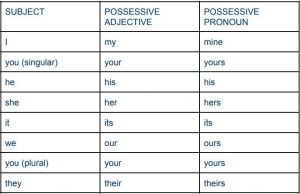

- The car in the front is mine.
- There are many keys here. Which of these are yours?
- a former colleague of mine
- an old friend of hers
 I met another colleague of … yesterday
a) hers (true) b) her (false)
- Whose book is this?
- Whose is this book?
- It’s important to have a belief of one’s own. (NOT ……of one’s)
- I’ve eaten my fish and the cat has eaten its fish too. (NOT ……and the cat has eaten its.)
- A: My bike is broken. Can I borrow yours?
B: Why don’t you ask Dan?
A: I can’t use his as it is too big.
B: Ok. I can give you mine as long as you bring it back before dinner.
- Casie is a neighbour of James’./She is a neighbour of his.
- Bob and Patrick called a friend of theirs to ask for money.
- At the end of the term we went on a picnic with a teacher of ours and had quite a nice time together.
- What do you think of this new haircut of mine?
- My aunt showed me a few photographs of me, which she took in her own house.
- I showed my aunt some of the photographs of mine when I went to Long Lead.
- The soldier was wounded on the head.
- I suddenly turned back when someone tapped me on the shoulder.
The post Possessive Pronouns appeared first on Learn English Fondly.
]]>SIMPLE PRESENT TENSE Simple Present Tense mentions verbs that we always do and general truth. AFFIRMATIVE I save money. YOU save money. WE save money. THEY save money. NOTE: Infinitive form of the verb –that’s bore infinitive are used with subjects “I,YOU,WE and THEY” at Simple Present Tense. *** HE saves money. SHE saves …
The post SIMPLE PRESENT TENSE appeared first on Learn English Fondly.
]]>SIMPLE PRESENT TENSE
Simple Present Tense mentions verbs that we always do and general truth.
AFFIRMATIVE
I save money.
YOU save money.
WE save money.
THEY save money.
NOTE: Infinitive form of the verb –that’s bore infinitive are used with subjects “I,YOU,WE and THEY” at Simple Present Tense.
*** HE saves money.
SHE saves money.
IT saves money.
NOTE: “HE,SHE and IT” subjects’ verbs take “-s, -es, -ies” suffixes.
NEGATIVE
I don’t save money.
YOU don’t save money.
HE doesn’t save money.
SHE doesn’t save money.
IT doesn’t save money.
WE don’t save money.
YOU don’t save money.
THEY don’t save money.
NOTE: Negation Particle “NOT” is used at the negative sentences. “NOT” means no.It is used with “DO NOT(DON’T)” auxiliary verb and the infinitive form of the verb after the subjects “I, YOU, WE and THEY”. It is used with “DOES NOT(DOESN’T)” auxiliary verb and the infinitive form of the verb after the subject “HE, SHE and IT”.
QUESTION
DO I save money ?
DO you save money ?
DO we save money ?
DO they save money ?
DOES he save money ?
DOES she save money ?
DOES it save money ?
NOTE: DO and DOES come to the fore, then the subject and the infinitive form of the verb are used at the question sentences.
TIME EXPRESSIONS FREQUENTLY USED IN SIMPLE PRESENT TENSE
always
almost always/nearly always
usually
generally
often
frequently
sometimes
occasionally
seldom
rarely
scarcely
scarcely ever
barely
ever
not ever
never
almost never
at times
once in a while
from time to time
now and then
every day/week/month/summer …
once/twice … a month/ a year …
at the weekends/on weekends
on Mondays/Sundays …
on weekdays
in the mornings/at nights …
every two days/every three weeks …
- Habits, repeated actions:
*During weekdays, I try to get an eight-hour sleep so that I can feel energetic at work.
*As a teacher, Semra always has extra work to do at home because she prepares lesson plans for the next day.
- Generalisations, natural laws, universal truths:
*Hurricanes occur when the warm air from the surface of the ocean rises and meets the cooler air.
*Trees grow more quickly when they are young.
- Situation or actions that its validity is continuous and permanent:
*Brian lives in a modest house although he earns quite a lot of money.
*Harrods, the famous shopping mall in Britain, sells a large variety of goods.
- Present time expression that is formed without using “-ing” appendix with the verbs that don’t include actions but reporting the situation:
*Serkan doesn’t know how to use the fax machine so he needs your help.
*She wants to ask a question but she doesn’t want to interrupt him now.
- Headlines:
*Germany beats Argentina in the semi finals of the 2010 World Cup.
*Prime Minister attends a special ceremony and makes a speech there.
- Book, movie summaries; story, short feature telling and sport reviews:
*One day, the princess comes to the palace and comes together to her father.
*Messi kicks the ball and scores the goal of his team.
- Performative verbs ( accept, acknowledge, assume, believe, deny, hope,
inform, promise, think…) :
*I believe in faeries.
*I hope you won’t expect results immediately.
USE OF FREQUENCY ADVERBS IN SIMPLE PRESENT TENSE
- If we want to know how often an act is done, we need to ask “How often” question to the verb.
*Mary is always in charge.
*I never promise anybody anything.
- Frequency adverbs are always used between the subject and the verb before the actual verb. But this adverbs are used after the verb “be(am, is, are)”.
*Our teacher usually lets us free.
*Elena is sometimes pessimistic about the future of the company due to the economic crisis.
- But if “be” verb is in negative construction, the usage may change.
*My sister sometimes isn’t pleased with surprises.
VERY IMPORTANT
“Always” must indicate after the appendix that specifies negative.
*First impressions aren’t always correct.
- “Usually, normally, often, frequently, sometimes ve occasionally” may locate at the beginning or end of the sentences. But, “always, never, rarely ve seldom” don’t always locate at the beginning or end of the sentence.
*Sometimes I enjoy playing computer games especially after a hard day.
- “Frequently, sometimes, occasionally” must come before the negative auxiliary verb.
*He sometimes doesn’t feel like going to work. ( feel like= wish, want )
- “Usually, generally, often” may come after the negative auxiliary verb or before the negative auxiliary verb.
*My mother doesn’t often go shopping herself; instead, she prefers shopping online.
- “Never, seldom, rarely, hardly ever” carry negative meaning. This adverbs are used with the positive verb structure but they make negative the meaning of the sentence.
*My son never makes his bed, which always drives me crazy.
VERY IMPORTANT
If the adverbs that carry negative meaning locate at the beginning of the sentence, it is compulsory that the sentence is made inverted.
** Rarely do I watch football matches.
**Never does Smith show tolerance to his employees if anything goes wrong.
The post SIMPLE PRESENT TENSE appeared first on Learn English Fondly.
]]>